Book a historic Kyoto ryokan with private onsen
A Kyoto ryokan may sell itself as “historic,” “intimate,” and “with private onsen” at a nightly rate that would make a grand European hotel blush. However, those three phrases do not automatically describe the same thing.
So the practical question is not merely where to stay. It is how to check and book a historic Kyoto ryokan with private onsen without mistaking mood lighting for provenance, or a tiled bathroom for a spring-fed bath. I have inspected enough “traditional” rooms with suspiciously new plasterboard and enough “onsen” baths connected to very ordinary plumbing to say this plainly: in Kyoto, the booking page is often less a description than a negotiation with ambiguity.
Distinguishing authentic heritage from modern replicas
Kyoto is unusually good at selling atmosphere. A narrow entrance, a noren curtain, a low shoe step, a corridor of polished timber — the visual grammar is powerful. It is also easy to reproduce. The better replicas now understand restraint: no vulgar gold, no souvenir-shop lanterns, no assault of synthetic incense. They present themselves as “bespoke” and “locally rooted.” Sometimes they are. Sometimes they are a hotel development with a heritage costume department.
When I assess a ryokan claim, I separate four things that marketing prefers to blur:
1. The age of the operating inn. Has the ryokan been receiving guests for generations, or is the building merely old? A merchant house converted last year can be architecturally interesting, but it is not the same as an inn with continuous ryokan practice.
2. The survival of the physical fabric. Original timber, garden layout, ceilings, joinery and room proportions matter. So do the compromises: inserted bathrooms, widened corridors, new seismic work, elevator shafts and kitchen ventilation. Some retrofits are responsible. Others leave only a decorative footprint.
3. The ryokan service model. A true ryokan stay is structured: arrival, room explanation, bathing, kaiseki or traditional dinner, futon preparation, breakfast. If the property operates like a boutique hotel with tatami mats, say so.
4. The bath arrangement. “Private onsen” may mean an in-room tub, a reservable family bath, or a paid time slot in a facility shared by other guests. These are not minor distinctions when the rate is built around privacy.
The Japan Ryokan and Hotel Association maintains a standardized search portal for registered traditional inns. I use that kind of verification as a first filter, not as a final blessing. Registration confirms a category; it does not audit taste, restoration quality, staff fluency, futon comfort, noise transfer, or whether the “garden view” is a hedge and an air-conditioning unit having a private conversation.
Kyoto rewards the guest who reads nouns literally: ryokan, onsen, private, historic. Each word needs its own inspection.
A modern replica is not automatically poor. Some are cleaner, quieter and better engineered than the elderly inns whose charm is doing heavy lifting over tired plumbing. But if I am paying for heritage lodging, I want to know what is old, what is copied, and what has been replaced behind a tasteful screen.
A useful sign is specificity. Strong properties tend to describe the building type, district, room categories, bath type and meal service with calm precision. Weak ones lean on adjective fog: “timeless,” “authentic,” “hidden,” “premium,” “curated.” I do not object to romance. I object when romance is used as a smoke machine.
The reality of Kyoto onsen: natural springs versus kanko-sen
The most expensive misunderstanding in this market is the word “onsen.” Many travellers arrive assuming that a private onsen in Kyoto means natural hot spring water rising from volcanic geology. That assumption works better in classic hot spring towns than in central Kyoto.
In central Kyoto, many ryokans use kanko-sen — heated tap water — rather than natural volcanic hot spring water. This is not necessarily a scandal. A deep cedar tub filled with clean, hot water in a quiet room can be extremely satisfying. But it is not the same product as a natural mineral spring, and the rate should be read accordingly. True natural onsen are more common toward the outskirts, including areas such as Arashiyama and Kurama, where the geography and lodging pattern differ from the dense central grid.
Here the booking language matters. Look for whether the property states:
- that the bath uses natural hot spring water;
- whether the water is circulated, heated, filtered or drawn from a source;
- whether the bath is in-room, outdoor, indoor, or reservable;
- whether bathing tax or onsen tax is mentioned;
- whether the Japanese-language page says something more precise than the English page.
If the English version says “private hot spring-style bath” while the Japanese page avoids the natural spring claim, I treat that as a warning light. Not a conviction. A warning light.
| Term on booking page | What it may mean in practice | What I would ask before paying |
|---|---|---|
| Private onsen | Could be natural spring water, or could be loosely used for a private hot bath | Is the water natural hot spring water or heated tap water? |
| Rotenburo | Outdoor bath, often in-room or attached to a suite, but not always spring-fed | Is it private to the room, and what is the water source? |
| Uchiburo | Indoor bath; may be private, shared, or in-room | Is it a standard bath or an onsen bath? |
| Kashikiri | Private rental bath reserved for exclusive use during a time slot | How long is the slot, and can it be reserved before arrival? |
| “Semi-open-air” bath | A bath with partial ventilation or a window; sometimes delightful, sometimes semantic gymnastics | Is it actually outdoors, and can neighbouring rooms see or hear it? |
This is where the heritage building itself imposes reality. A 19th-century timber inn was not designed with multiple en-suite mineral baths, silent drainage and humidity control. Adding these elements without damaging the building is expensive and technically awkward. The same is true in historic quarters across the world: the challenge is not only aesthetics but materials, waterproofing, ventilation and load. Anyone interested in the building side of restoration can find useful context in discussions of architecture, renovation and construction materials, because the romance of a bath usually depends on unromantic decisions hidden behind the wall.
Kyoto’s best operators are honest about these constraints. They do not pretend an old building can absorb every luxury-hotel amenity without consequence. The dubious ones offer the full fantasy: centuries-old character, vast private bathing, perfect soundproofing, central location, no compromise. That combination exists only rarely, and when it does, it is priced with confidence.
Navigating private bath options: in-room rotenburo versus kashikiri
The phrase “private onsen” is especially slippery because privacy can be attached to the room or to a schedule. Guests often discover this too late.
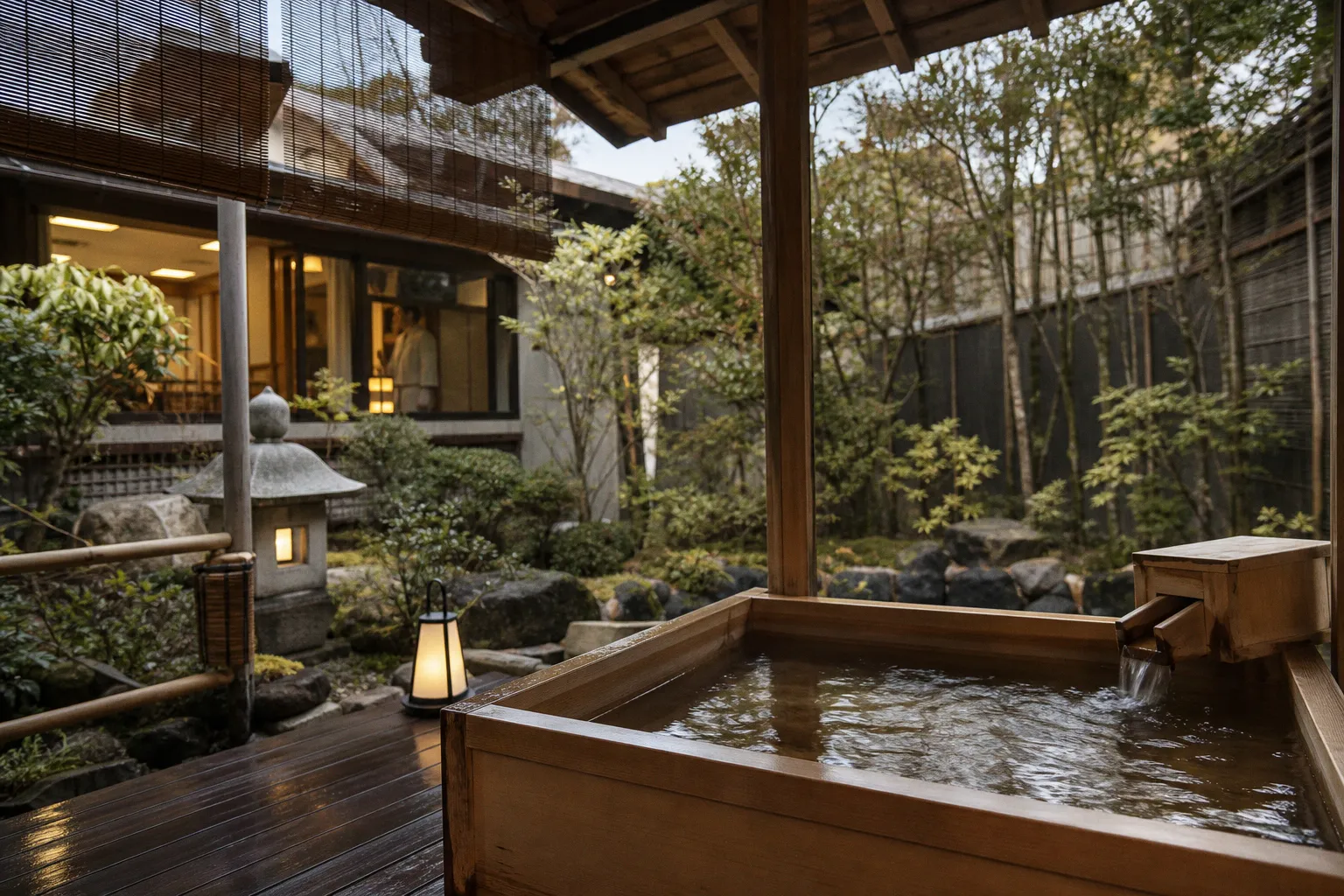
An in-room rotenburo is the premium version most people imagine: a private open-air bath attached to the room or suite. It may look onto a garden, courtyard, mountain slope or, less enchantingly, a privacy fence. In Kyoto, especially in central properties, this can be a compact architectural solution rather than a cinematic pool. The footprint is often tight. You may be bathing beside a screen, under a slatted roof, with a carefully edited view. That is not a defect if disclosed. It is a defect if sold as spacious seclusion.
An uchiburo is an indoor bath. In heritage ryokans, an in-room indoor bath may be more plausible than a true outdoor bath because it can be inserted with less exposure to weather and neighbours. Some are beautiful. Some are essentially hotel bathrooms wearing hinoki perfume.
A kashikiri bath is a private rental or reservable bath. This can be excellent for couples, families or guests with tattoos who are uncertain about public bathing etiquette. However, it is private only during the reserved slot. It may be free or charged; it may be booked at check-in; it may be impossible to secure at the hour you want if occupancy is high.
Before booking, I would ask the property these questions in writing. Not because I enjoy bureaucracy — though it has its uses — but because written answers reduce the chance of a smiling disappointment at reception.
1. Is the private bath attached to my room, or is it a reservable kashikiri bath?
This is the central distinction. If the bath is not attached to the room, the room category should not be priced as though it were.
2. Is the water natural hot spring water or heated tap water?
A polite property will answer directly. Evasion usually arrives dressed as “relaxing,” “traditional,” or “Japanese-style.”
3. Can the kashikiri bath be reserved before arrival?
If not, your “private onsen stay” may depend on check-in order and occupancy.
4. How long is the private bath slot?
Thirty minutes and sixty minutes are different products. So are one-time use and repeated access.
5. Is the bath indoor, open-air, or semi-open-air?
“Open-air” has become a flexible term. Ask for the physical reality, not the mood board.
6. Are meals served in-room, in a private dining room, or in a shared dining space?
Bath privacy and dining privacy are often bundled in the imagination but separated in operations.
A private bath that cannot be reserved until arrival is not a promise. It is an inventory gamble with better towels.
The better booking platforms sometimes help by filtering room categories and displaying photographs with more discipline than global mass-market sites. In Japan, platforms such as Relux and Ikyu are often more useful for high-end ryokan stays than broad international booking engines, particularly when the property is small, traditional, or not fully optimized for global distribution. That does not mean every listing is perfect. It means the vocabulary and categories tend to be closer to the local market.
Strategic booking windows for peak season reservations
Kyoto’s heritage lodging market is not elastic. A modern hotel can add rooms by building vertically. A historic ryokan cannot casually expand without destroying the thing it is selling. The number of rooms with credible heritage character and private bathing is small, and the number of travellers who want them during peak season is large.
For late March to early April, when cherry blossoms pull demand across the city, I would start looking three to six months ahead. For November, when autumn foliage does similar work with more sober colours and equally unsober rates, use the same window. If the ryokan is famous, tiny, or has only one or two rooms with private bathing, six months is not excessive. It is merely realistic.
The booking route matters. I usually compare three channels:
| Booking route | Strength | Weakness |
|---|---|---|
| Official ryokan website | Best chance of direct room descriptions, meal policies and special categories | English pages may be thin; availability calendars can be clumsy |
| Curated Japanese luxury platforms such as Ikyu or Relux | Better coverage of high-end domestic ryokans and room-level detail | Some nuance may still depend on Japanese text and machine translation |
| Global booking sites | Familiar interface, easier cancellation comparison | Heritage vocabulary often flattened; private bath details may be imprecise |
For a transactional stay — the kind where the bath, meal timing and room type are the point — I do not treat all channels equally. A cheaper rate on a mass booking site may be attached to a less desirable room category, no dinner, a stricter cancellation rule, or no access to the bath arrangement you thought you were buying. Rate comparison is useful only after the product is identical. Frequently, it is not.
I also watch for how a ryokan handles children, solo travellers and consecutive nights. Some traditional properties restrict children in certain room types. Some prefer two-person occupancy because the meal operation and room economics are built that way. Some do not offer one-night stays during peak dates. These are not moral failings; they are occupancy management. But they should be visible before you enter card details.
If you are booking through a platform, read the room name like a contract. Japanese accommodation names can be long because they encode the product: room size, view, bath type, meal plan, smoking status, and sometimes building wing. The English truncation may remove the very clause you need. If two room categories differ by a few hundred dollars, do not assume the expensive one is “nicer” in a general sense. It may simply include an open-air bath, a larger garden aspect, or dinner in a private room.
Essential logistics: check-in times and traditional dinner service
Historic ryokans run on a tighter schedule than hotels. That is part of their grace and part of their inconvenience. Standard check-in is often around 15:00 to 18:00, and late arrival is not treated as a casual matter. This is especially true when dinner is included.
A ryokan dinner is not a room-service burger waiting under a heat lamp. Kaiseki and traditional multi-course meals are timed, staffed and paced. Ingredients are prepared for a sequence; futons may be laid while guests dine; baths are scheduled around the evening rhythm. Arriving at 20:30 after a delayed train may be understandable. It may also mean the kitchen cannot serve what you paid for.
This is where inexperienced guests confuse hospitality with infinite flexibility. A small ryokan with ten rooms is not a 300-key business hotel with a night manager, vending machines and a lobby bar. Its labour model is intimate and brittle. That brittleness can be charming when everything works. It becomes expensive when your flight lands at Kansai in the late afternoon and your itinerary assumes Kyoto traffic will be ornamental.
I recommend treating arrival day as a protected operation:
- Do not schedule an ambitious sightseeing day before check-in. Store luggage, arrive cleanly, and let the ryokan sequence begin.
- Tell the property if you will arrive after 18:00. Better still, do not arrive after 18:00 unless the ryokan explicitly accepts it.
- Confirm dinner inclusion and serving time. Some rates are room-only, some include breakfast, and the full ryokan experience usually means dinner and breakfast.
- Ask where dinner is served. In-room dining is not universal, especially in renovated historic buildings where staff circulation and food safety rules have changed the operating pattern.
- Check bedding arrangements. Futons on tatami are traditional; mattress toppers and Western beds may be available only in certain rooms. A bad assumption here can make the heritage experience feel like a disciplinary exercise.
- Clarify luggage handling and stairs. Old buildings can have steep stairs, no elevator, narrow corridors and thresholds that were not designed for hard-shell luggage the size of a small shrine.
The private bath schedule should be folded into this rhythm. If you have a kashikiri slot, ask whether it is best taken before dinner, after dinner, or the next morning. In some properties, evening slots vanish quickly. In others, the morning bath is the quiet prize because most guests are busy discovering how elaborate breakfast can be.
What I look for in photographs
Photographs are useful, but not in the way booking pages intend. I ignore the tray of tea, the artfully placed sandals and the single flower in a vase. Those are props. I look at corners.
Corners reveal renovation quality. Does the new bathroom meet old timber with care, or with a bead of white sealant doing emergency diplomacy? Is the tub edge properly detailed? Is there visible condensation damage? Are there grab rails, drainage channels, ventilation grilles? Does the outdoor bath sit in a credible garden setting or in a boxed-in light well?
I also compare image sets across languages and platforms. The official site may show the room at its most poetic. A domestic platform may show the bath plan more plainly. A global site may recycle generic property images. If a room category with a private rotenburo has no clear photograph of the actual bath, I assume nothing.
There is a peculiar genre of ryokan photography in which the bath is shot at night, steam rising, lantern glowing, no edges visible. It is beautiful. It is also a velvet curtain over useful information. Daylight photographs are less flattering and more honest.
Price, cancellation and the cost of vagueness
Historic Kyoto ryokans with private bathing can move from expensive to absurd during peak periods. The issue is not only the headline rate. It is what the rate includes and what it risks.
Meal-inclusive plans can appear high until compared with the cost and quality of a serious kaiseki dinner elsewhere in Kyoto. Conversely, a room-only plan in a “heritage” property can be poor value if the room is small, the bath is not private, and the service model is essentially hotel-lite. I would rather pay clearly for a full traditional stay than be sold fragments of one.
Cancellation terms deserve more attention than they receive. Small ryokans cannot resell a room as easily as large hotels, especially when dinner ingredients and staffing are attached to the booking. Stricter cancellation policies are common and often reasonable. The problem arises when a guest books vaguely, assumes the bath is in-room, then discovers the truth inside the penalty window.
There is also the question of language. Many fine ryokans operate with limited English, and that alone should not disqualify them. But if the product is expensive and technically specific — natural spring, private bath, meal timing, dietary restrictions — the communication needs to be precise. If you have serious dietary requirements, do not rely on a booking-note field and optimism. Ask before booking. Traditional kitchens may not be able to remove dashi, soy, wheat, fish stock or multiple allergens without dismantling the meal.
A practical booking sequence that avoids the common traps
When I book or audit this category, I use a sequence that is less romantic than the brochures but considerably cheaper than disappointment.
1. Choose the district first, not the bath.
Central Kyoto gives access to temples, markets, restaurants and walking routes, but natural hot spring water is less likely. Arashiyama or Kurama may improve the onsen proposition, but the stay becomes more retreat-like and less urban.
2. Shortlist only properties that state the bath type clearly.
I want to see rotenburo, uchiburo or kashikiri used in a way that corresponds to photographs and room categories.
3. Verify whether “onsen” means natural spring.
If the property says kanko-sen or avoids the natural spring claim, price it as a private hot bath, not as a mineral onsen.
4. Check ryokan authenticity through a recognized association or credible domestic platform.
This helps separate established inns from boutique hotels borrowing the vocabulary.
5. Compare the official site with Ikyu or Relux.
Discrepancies in room category descriptions often reveal what the English marketing has smoothed over.
6. Email the property with specific questions.
Ask about water source, private access, reservation slots, meal time and check-in deadline. Vague questions invite vague answers.
7. Book early for blossom and foliage seasons.
Three to six months ahead is a sensible working range; the best rooms do not wait for indecisive romantics.
8. Preserve the arrival window.
Plan to reach the ryokan between 15:00 and 18:00. If dinner is included, this is not optional etiquette; it is the operating system.
This procedure lacks glamour. So does checking the load-bearing capacity of a balcony. Both are preferable to discovering, at full occupancy, that your “private onsen” is a shared bath with a sign-up sheet and a 40-minute slot after breakfast.
The right compromise
The ideal Kyoto ryokan stay is not the one with the longest adjective chain. It is the one where the physical building, bath arrangement, meal service and price are in honest alignment. A central historic inn with superb service and a private kanko-sen bath may be a better stay than a strained “luxury” property pretending to offer a mountain onsen in the middle of the city. A modest kashikiri bath in a well-run traditional inn may deliver more privacy in practice than an over-photographed in-room tub exposed to neighbour noise and mechanical hum.
My skepticism is not hostility to the ryokan tradition. Quite the opposite. The tradition deserves better than being flattened into a premium amenity label. Kyoto’s old inns operate within real architectural limits: timber frames, compact plots, conservation pressures, kitchen schedules, staff rituals, water sources. The best ones turn those limits into hospitality. The weaker ones hide them behind “heritage” copy.
To book well, be literal. Ask what is old. Ask what is private. Ask what is spring-fed. Ask when dinner is served. Then pay for the answers you actually receive, not for the atmosphere the photographs encourage you to invent.