Check UNESCO Conservation Status of European Old Towns
A European old town is not “UNESCO protected” because it has stone paving, medieval street widths, or a market square with reconstructed façades. The designation is a legal and documentary condition. It can be verified.
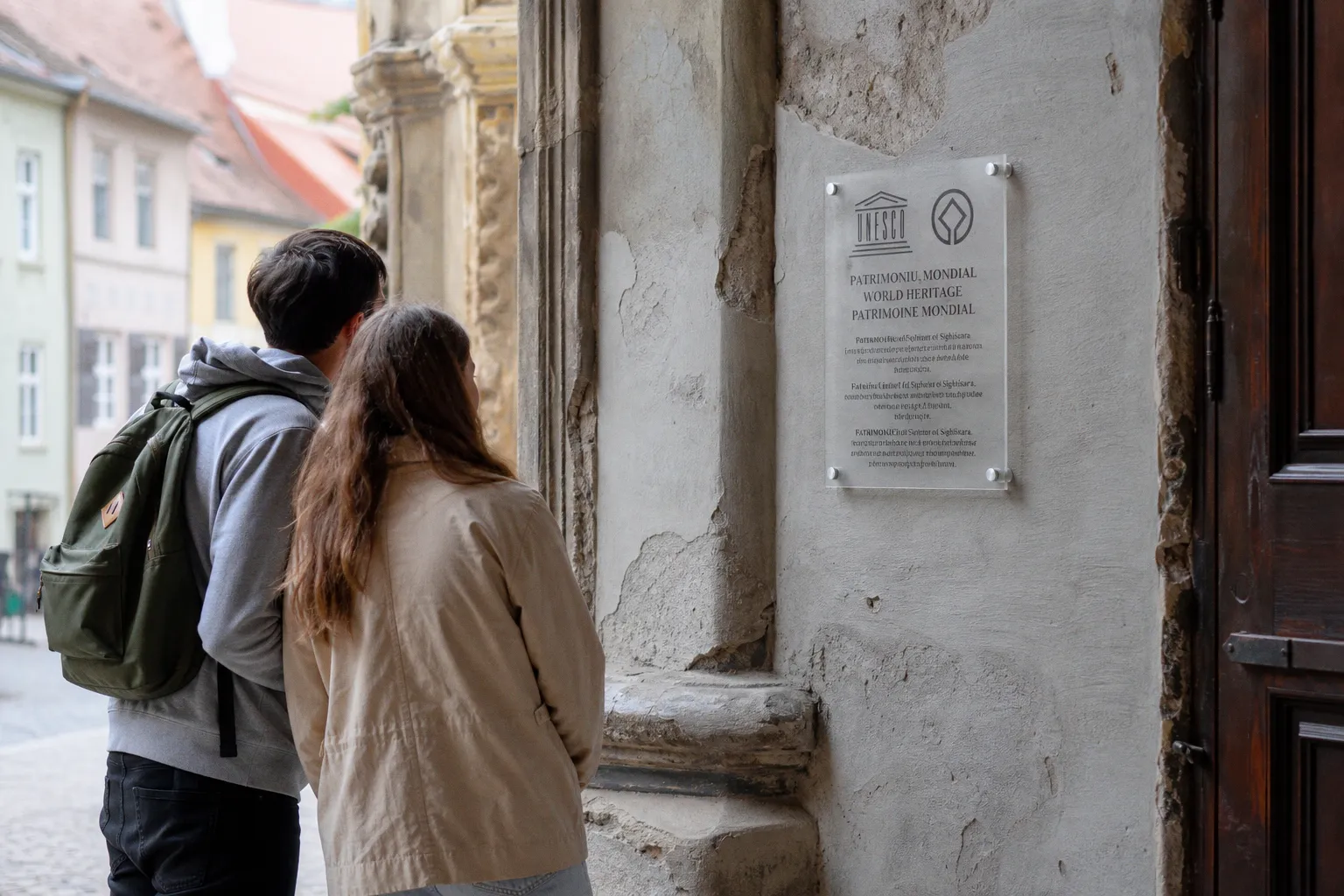
The practical question for heritage travelers is therefore not whether a place looks old. It is how to check check unesco conservation status of european old towns without relying on hotel copy, municipal slogans, or plaque-level shorthand. The answer begins with the official World Heritage record, then moves into State of Conservation files, national monument registers, local planning controls, and the less visible mechanics of enforcement.
The UNESCO record is a register, not a mood
The World Heritage List is the primary source. It is maintained by the UNESCO World Heritage Centre and records properties inscribed under the 1972 Convention Concerning the Protection of the World Cultural and Natural Heritage. As of current 2024/2025 figures, the list contains 1,223 inscribed properties globally. The Convention has 195 States Parties. These numbers matter because they define the scale of the system. It is not a European old-town catalogue. It is an international treaty framework.
For a traveler assessing a historic quarter, the first distinction is between three common conditions:
| Claim encountered in travel material | What it may actually mean | What must be checked |
|---|---|---|
| “UNESCO town” | The old town may be part of an inscribed World Heritage property | Official World Heritage List entry by property name and country |
| “UNESCO candidate” | The site may be on a Tentative List, not inscribed | National Tentative List and nomination status |
| “Protected historic centre” | It may be controlled under national or municipal law only | National monument register, local conservation area, zoning plan |
| “Near a UNESCO site” | The town may sit outside the inscribed boundary or buffer zone | Official maps and boundary documents |
| “Restored with UNESCO support” | It may have received advice, attention, or project association, not inscription | Project documentation and World Heritage status separately |
The official entry normally gives the property name, country, year of inscription, criteria, boundary information, and related documents. For old towns, the named property may not match the tourist name. “Historic Centre,” “Old City,” “Medieval Town,” and “Urban Ensemble” are not interchangeable labels. They refer to defined areas, often with mapped boundaries.
The boundary is the technical core of the listing. It separates the inscribed property from adjacent urban fabric. A street outside the line may be visually continuous with the historic centre but legally outside the World Heritage property. A building inside the buffer zone may be subject to height or view-corridor restrictions without being inside the property itself. This is common in dense European towns where defensive walls, riverfronts, monastic precincts, and nineteenth-century extensions sit in close contact.
A visitor reading a UNESCO entry should therefore look for five elements:
1. The exact property name. Marketing names often compress or expand the official designation.
2. The inscription year. It indicates when the property entered the system and what conservation arguments were accepted at that time.
3. The criteria. Cultural criteria describe why the site was judged to have Outstanding Universal Value. They are not a general approval of every building in the town.
4. The boundary and buffer zone. These define the area under World Heritage consideration.
5. Documents and reports. These show subsequent monitoring, concerns, or corrective measures.
A World Heritage boundary is not scenery. It is an administrative line with conservation consequences.
State of Conservation reports: where the masonry becomes political
The most useful documents are often not the inscription pages. They are the State of Conservation reports. UNESCO publishes SOC reports annually for properties facing threats or undergoing significant restoration, intervention, or monitoring. For European old towns, these reports can reveal the actual stresses behind the postcard surface: redevelopment pressure, traffic management, roofscape alteration, infrastructure works, visitor load, inappropriate materials, or delayed management plans.
The language is formal. It is also specific. A report may refer to visual integrity, authenticity, buffer-zone control, archaeological deposits, flood protection, mass tourism, or new construction. Each term carries technical weight.
“Integrity” concerns the completeness and legibility of the heritage property. In an old town, that may include street pattern, building volumes, parcel structure, fortification lines, skyline, and relationship to landscape. A town can retain isolated monuments while losing integrity through oversized infill, cumulative roof conversions, or road widening.
“Authenticity” concerns the credibility of attributes. In historic urban fabric, this may involve original masonry, timber structure, lime mortar, spatial hierarchy, craft techniques, and continued use. A rebuilt façade can contribute to townscape continuity, but it does not automatically carry the same evidential value as retained load-bearing fabric.
“Management system” is less photogenic. It is often decisive. A town may have a conservation plan, but the relevant test is whether planning decisions, permits, enforcement, maintenance obligations, traffic policy, and tourism management operate as one system. Fragmented administration can damage a historic centre without a single conspicuous demolition.
How to read an SOC report without overreading it
A State of Conservation report is not a travel warning. It is a monitoring instrument. The presence of a report does not mean the old town is failing. It means the property has attracted formal attention.
The sequence of reading should be mechanical:
1. Identify the property and year. Reports are year-specific. A concern raised in one cycle may be resolved, repeated, or escalated later.
2. Separate threats from recommendations. A report may describe a potential impact, request documentation, or call for corrective measures. These are different levels of concern.
3. Look for recurring vocabulary. Repeated references to development pressure, inadequate buffer-zone control, or major infrastructure proposals indicate structural issues.
4. Check whether the issue concerns the inscribed area or its setting. Many disputes arise in buffer zones, approach roads, riverfronts, and hillside views.
5. Distinguish conservation work from alteration. Restoration, retrofitting, drainage works, and adaptive reuse can be necessary. The question is method, material, reversibility, and scale.
A traveler examining an old town’s preservation condition can learn more from two pages of SOC language than from ten promotional essays. The reports show where the conservation system is under load.
The “In Danger” list is serious, but it is not the only warning signal
The List of World Heritage in Danger identifies properties threatened by serious and specific dangers. These may include armed conflict, natural disaster, uncontrolled urban development, major infrastructure, abandonment, or severe management failure. The current global figure is 56 properties on that list.
For European old towns, inclusion on the In Danger list is significant. It indicates that the World Heritage Committee has recognized threats requiring focused corrective action. But absence from the list should not be treated as proof of stable conservation. Many properties face cumulative pressure without crossing the threshold for danger listing.
This distinction is often missed. A historic centre may be affected by short-term rental conversion, loss of resident services, façade retention with interior demolition, roofscape changes, or drainage failures in medieval masonry. These pressures may not produce immediate danger-list status. They can still alter the old town’s structural and social fabric.
The In Danger designation is also not a direct enforcement mechanism. UNESCO does not arrive with an injunction to stop a crane. The World Heritage system works through States Parties under the 1972 Convention. National governments accept obligations, submit reports, coordinate with local authorities, and respond to Committee decisions. Enforcement remains a national and local matter.
UNESCO can identify risk and require response. It does not replace the building inspector, the planning court, or the municipal conservation officer.
Local protection may be stricter than UNESCO status
Some of Europe’s most rigorously controlled historic quarters are not World Heritage properties. Conversely, some World Heritage towns contain buildings under variable levels of national and municipal protection. The categories overlap but do not merge.
National monument laws often protect individual buildings, archaeological layers, façades, interiors, street alignments, or conservation zones. Municipal zoning can regulate height, roof pitch, materials, signage, window proportions, paving, excavation, and use. These systems may be older, more detailed, and more immediately enforceable than UNESCO status.
This is the principal error in many travel discussions. UNESCO designation is treated as the highest and most operational form of protection. In practice, the daily survival of an old town often depends on local instruments: permit review, heritage impact assessment, maintenance requirements, tax incentives, conservation grants, penalties, and planning appeals.
A simplified comparison is useful:
| Protection layer | Main function | Typical authority | What it can affect |
|---|---|---|---|
| UNESCO World Heritage inscription | Recognition of Outstanding Universal Value and international monitoring | State Party and World Heritage Committee | Broad conservation obligations, reporting, management expectations |
| State of Conservation process | Monitoring of threats and responses | UNESCO advisory and committee system through national reporting | Development pressure, restoration concerns, management deficiencies |
| National monument designation | Legal protection of buildings, sites, or districts | National heritage agency or ministry | Demolition, alteration, excavation, restoration methods |
| Municipal conservation zoning | Day-to-day control of urban form | City planning authority | Height, materials, façades, shopfronts, roofscape, use |
| Building permit system | Approval of specific works | Local or regional authority | Structural intervention, retrofitting, services, accessibility, fire safety |
The technical field where these systems meet is often retrofit. Old towns must adapt to fire codes, seismic requirements, accessibility standards, energy performance, drainage, and services. A medieval masonry building cannot be treated like a new concrete frame. Load paths, moisture movement, mortar composition, timber decay, and foundation settlement impose constraints.
This is where superficial “heritage-friendly” language becomes unhelpful. Replacing lime mortar with hard cement mortar may accelerate damage by trapping moisture and transferring stress to softer stone or brick. Installing services through historic wall cores can remove evidential fabric. Over-insulating a traditional wall can shift dew points and create condensation. Retaining a façade while demolishing the internal structural hierarchy may preserve street appearance but erase construction history.
Travelers do not need to become conservation engineers. They do need to understand that preservation status is not a decorative badge. It is a network of decisions about material behavior, legal authority, and urban pressure. For readers comparing contemporary approaches to building work and material selection, specialist architectural resources such as Bozdal Mimarlık’s architecture and renovation materials coverage can provide a parallel view of how material choices affect built fabric.
How to verify a European old town before visiting
The process should be sequential. It should not begin with a search-engine snippet.
1. Search the official World Heritage List by country and property name. Use both the English tourist name and the local name if necessary. Historic centres are often listed under formal names that differ from guidebook usage.
2. Confirm whether the old town is the property, part of the property, or outside it. Some listings include only a cathedral precinct, a fortified district, a palace complex, or a cultural landscape.
3. Open the map and boundary documents if available. The most common misunderstanding is assuming that the whole municipality is inscribed.
4. Check for State of Conservation documents. If present, read the latest report and compare it with earlier ones. Recurrence is more important than isolated phrasing.
5. Check whether the property is on the List of World Heritage in Danger. If it is, identify the stated threats. Do not infer unrelated risks.
6. Look for national and local protection designations. These may be found through heritage agencies, municipal planning portals, or conservation area documents.
7. Separate restoration news from conservation status. A scaffolding campaign may indicate maintenance, emergency stabilization, commercial redevelopment, or inappropriate intervention. The label alone is not diagnostic.
8. Consider urban pressures visible on the ground. Empty upper floors, uniform short-term rental signage, oversized hospitality terraces, façade-only redevelopment, and loss of workshops are all indicators of altered spatial economy.
This method is slow only the first time. After two or three towns, the pattern becomes clear. World Heritage status answers one question: whether a property has been inscribed for Outstanding Universal Value under the Convention. It does not answer every question about current condition.
What preservation status does not tell the traveler
A verified UNESCO listing does not guarantee that the visitor will encounter intact medieval fabric. It does not guarantee careful restoration in every building. It does not guarantee that local residents remain in the centre. It does not guarantee that the town’s economy has resisted conversion into a visitor-service monoculture.
The inverse is also true. A non-UNESCO old town may contain well-preserved street patterns, disciplined conservation controls, and high-quality repair practice. It may lack inscription because it has not been nominated, because it is considered of national rather than Outstanding Universal Value, or because similar properties already represent the typology on the list.
The technical condition of an old town depends on several layers that are rarely visible in a single designation:
- Parcel continuity. Medieval and early modern plots often encode the economic structure of the town. Consolidation for large commercial units can erase that grain.
- Structural retention. Original load-bearing walls, vaults, timber frames, and stair positions contain evidence that façades alone cannot provide.
- Roofscape discipline. Dormers, plant equipment, solar installations, and roof terraces can change skyline and drainage behavior.
- Ground-floor use. A historic centre made only of restaurants and souvenir retail has a different spatial hierarchy from one with workshops, food markets, schools, and services.
- Archaeological control. Utility trenches, basement extensions, and drainage works can disturb deposits below street level.
- Material compatibility. Stone, brick, timber, render, mortar, and metalwork require repair systems compatible with their original performance.
The visitor’s task is not to audit a municipality. It is to read claims accurately. “UNESCO” is a starting point. “Protected” is a question, not an answer.
The limits of international oversight
The World Heritage Convention created a framework for international cooperation and protection. It did not create a supranational planning authority. UNESCO status does not automatically provide restoration funding. It does not directly stop local construction. It does not replace domestic law.
This limitation is not a flaw hidden in the system. It is the system. States nominate properties. States accept obligations. States report. The World Heritage Committee reviews, recommends, and may place properties under closer scrutiny. The practical instruments remain permits, laws, budgets, technical offices, courts, and maintenance regimes.
For old towns, the most consequential damage is often incremental. One inappropriate shopfront is minor. Fifty change the street elevation. One roof terrace is manageable. A district of roof terraces changes the section of the town. One façade retention scheme may be defensible. Repetition turns a masonry settlement into a street-stage with new interiors behind old planes.
This is why conservation status should be read longitudinally. A single inscription date is not enough. A responsible assessment asks what has happened since inscription: whether management plans have been updated, whether buffer zones have been respected, whether infrastructure projects have been reviewed, whether restoration standards use compatible materials, and whether urban life remains functionally mixed.
The old town is a built record. Its evidential value sits in alignments, joints, load-bearing systems, voids, thresholds, and repairs. UNESCO documentation can help identify how that record is recognized and monitored. It cannot substitute for local enforcement or technical competence.
A precise conclusion
To check the UNESCO conservation status of a European old town, begin with the official World Heritage List. Confirm the exact property, boundary, inscription criteria, and associated documents. Then read any State of Conservation reports and verify whether the property appears on the List of World Heritage in Danger. After that, examine national and municipal protection, because those systems usually control the actual permits, materials, and interventions.
The result will often be less simple than the travel slogan. That is useful. A historic town is not preserved by atmosphere. It is preserved by law, documentation, compatible repair, restrained development, and continuous maintenance. UNESCO status is one layer in that structure. It is never the whole wall.