Beyond preservation: how cities are turning heritage into a tool for urban renewal
Heritage policy is moving from a defensive register to an urban-development register.
Adaptive reuse is becoming the operative model
The clearest example cited at the summit came from Hong Kong. Sunny Lo, Commissioner for Heritage’s Office, described the old Tai O Police Station, restored as the Tai O Heritage Hotel while retaining key original features of the police station. The project was initiated by the Hong Kong Heritage Conservation Foundation and enabled under Hong Kong’s “Revitalising Historic Buildings Through Partnership Scheme”, under which non-profit organisations, with partial government funding, can adapt historically significant buildings for functional use.
The important point is not that a former police station now serves visitors. It is that the building was not treated as a sealed exhibit. Its masonry envelope, internal circulation and retained elements were made part of a new operating structure. That is the practical distinction between preservation as storage and preservation as reuse.
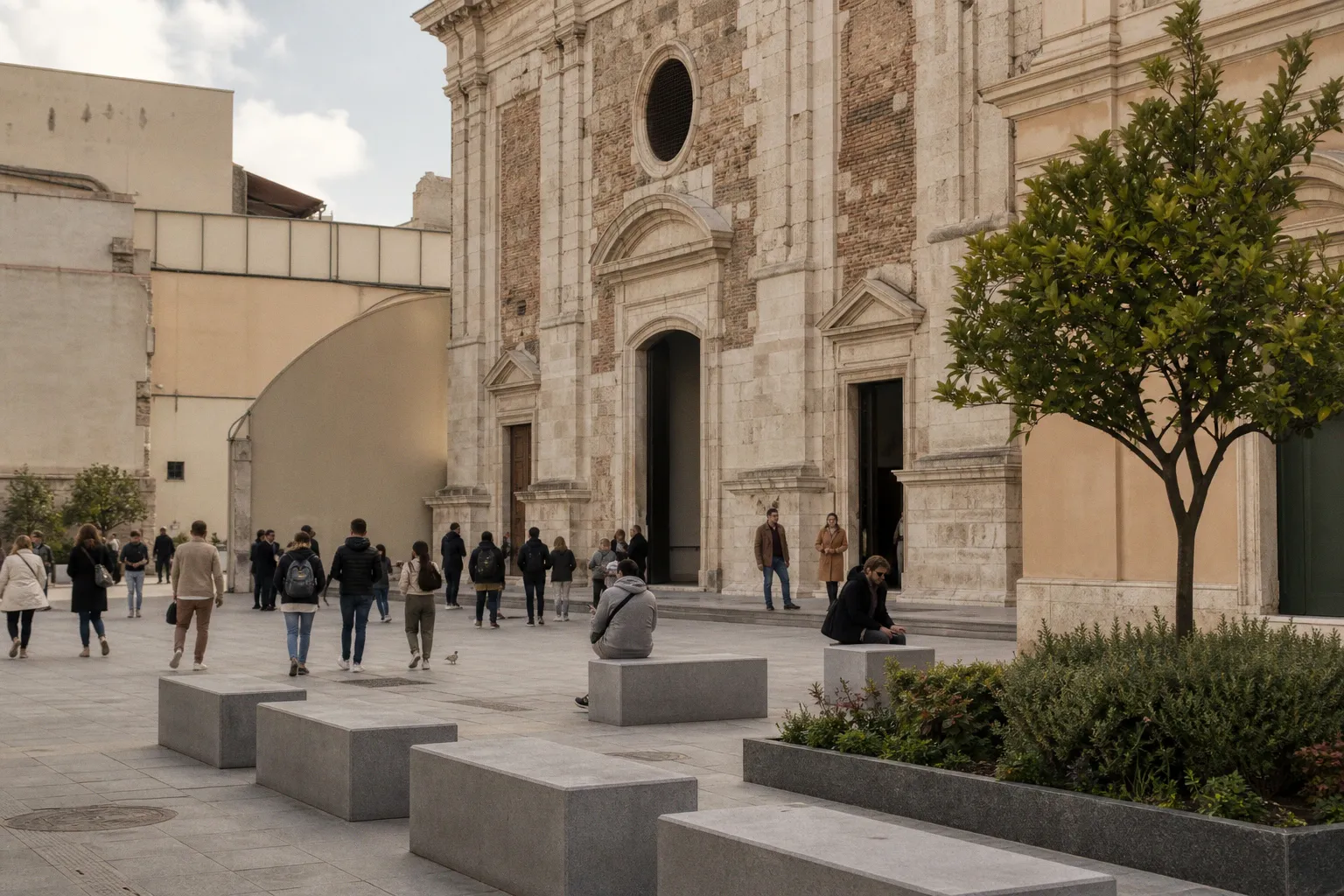
Coimbra offered a parallel case. Deputy Mayor Miguel Antunes referred to the conversion of old convent buildings, and even churches, into convention centres, while warning that the choice of use requires sensitivity. This is a technical caution, not a sentimental one. A large-volume ecclesiastical or monastic structure can absorb public functions, but only if the intervention respects load paths, thresholds, acoustics, access and the inherited order of rooms. A poor programme can damage a building without demolishing a single wall.
The old-town visitor should read policy before reading façades
The summit discussion also marked a wider change in vocabulary. Singapore Management University President Professor Lily Kong, who moderated the panel, argued that rapid transformation without cultural preservation risks producing sterile cities. Singapore’s Senior Minister of State Low Yen Ling framed the city not merely as steel, glass and concrete, but as a repository of memory, identity, history and culture.
For heritage travel, this language has a practical consequence. A district marketed as “renewed” may no longer be defined only by listed monuments or museum interiors. It may include walking trails, repurposed civic buildings, heritage hotels, night openings and cultural programming. These additions can improve public access. They can also redirect footfall away from older residential lanes and towards managed routes.
The reader should therefore check what kind of conservation regime is in operation. A protected site, an adaptive-reuse scheme and a museum-led cultural district produce different visitor conditions. One may preserve fabric but limit access. Another may open the building but alter its use. A third may preserve the exterior while placing the historical narrative inside signage, guided routes or ticketed programming. The façade alone is no longer a sufficient guide.
UNESCO status and museum hours are part of the same pressure system
The policy environment is also widening beyond single-city case studies. According to a UNESCO-related report, the World Heritage Committee is due to hold its 48th session in Busan, Republic of Korea, from July 20 to 29, 2026, where it will examine 30 new site nominations and the conservation status of 147 existing sites. Separately, Travel And Tour World reported that Italy has reached 61 UNESCO World Heritage sites. These figures, where confirmed by the reporting cited, show the scale of the formal heritage system that cities use when positioning themselves internationally.
At the operating level, Vietnam News reported that Ho Chi Minh City’s Department of Culture and Sports recorded progress in cultural heritage preservation and museum management, including the piloting of nighttime openings. That detail is small but structurally relevant. Extended hours change the use-cycle of heritage buildings. They alter staffing, lighting, security, conservation load and the way visitors distribute themselves across a historic area.
For old-town itineraries, the useful question is no longer only “what is preserved?” It is “what has been made operational, and under which rules?” A restored police station used as a hotel, a convent converted for conventions, a museum testing night access, and a city awaiting UNESCO scrutiny all sit on the same continuum. Heritage is being treated as infrastructure. The benefits are real access and continued use. The risks are over-programming, inappropriate retrofitting and the reduction of complex urban fabric to a managed visitor circuit.