Buy Edinburgh Vaults Historical Tour Tickets Safely
The South Bridge Vaults in Edinburgh consist of 19 vaulted chambers constructed beneath the South Bridge in 1788.
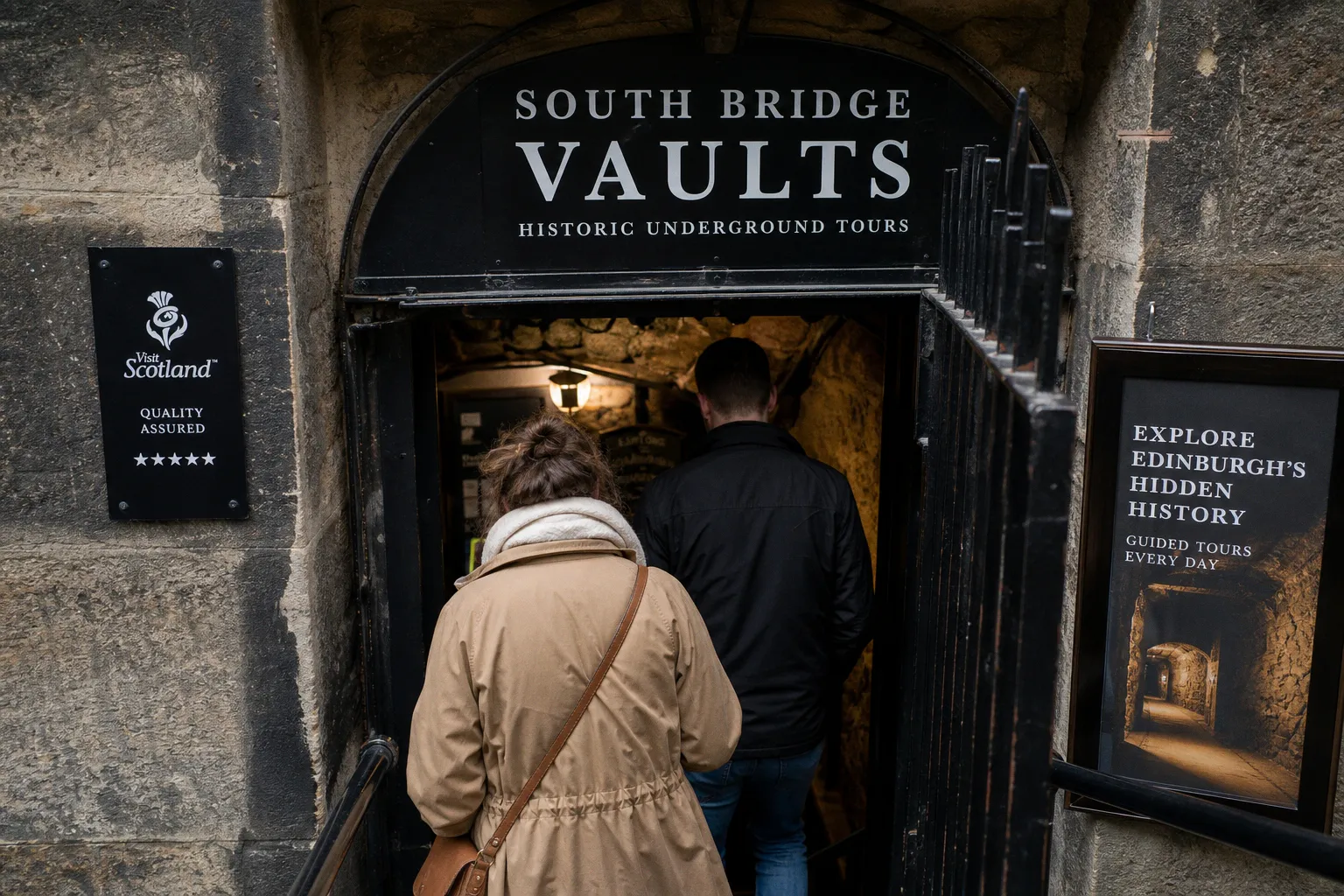
The South Bridge Vaults: 19 Chambers and No Central Authority
The absence of a single "official" provider means the market for Edinburgh Vaults tours functions less like a museum admission system and more like a set of competing concessions within a shared heritage asset. Verifying legitimacy requires checking specific institutional accreditations rather than looking for a government seal. The following analysis examines how the vaults are administered, what credentials distinguish authorized operators, how to identify fraudulent ticket sources, and what digital security protocols should govern any online transaction.
The Reality of Vault Management: Why No Single "Official" Tour Exists
The South Bridge was completed in 1788 as an infrastructure project connecting the Old Town's spine to the university district. The arches beneath it were enclosed as storage vaults and commercial spaces. By the early 1800s, conditions had deteriorated: the chambers lacked ventilation, drainage, and adequate structural reinforcement against water infiltration through the masonry. The vaults were progressively abandoned and eventually sealed.
For related context, see WordPress how-to, plugins and themes: WP tutorials, plugins, themes, WooCommerce,.
For related context, see Travel guide to India for foreigners: destinations and regions, itineraries, visa and.
Rediscovery and reopening began in the late 20th century. The spaces were divided among multiple private operators who invested in retrofitting, safety compliance, and interpretive programming. Each company secured leases or access agreements covering specific vault sections. The result is a patchwork: Company A controls a cluster on the south side; Company B operates in the deepest levels. No single entity holds a monopoly or a municipal concession covering all 19 chambers.
This matters for ticket purchasing because it eliminates the possibility of a single "official" website. Every legitimate operator is official within its own leasehold. The practical consequence is that a buyer must identify which company covers the historical areas they want to visit—paranormal-focused routes, architectural history walks, or combined surface-and-vault itineraries—then verify that specific operator's credentials independently.
There is no central ticket counter for Edinburgh's South Bridge Vaults. Nineteen chambers, multiple operators, zero unified authority — the only reliable verification method is checking individual company accreditation against a recognized standard.
Verifying Operator Credentials and VisitScotland Accreditation
VisitScotland, the national tourism body, operates a quality assurance accreditation program. Operators that meet its service and safety standards receive formal recognition, which can be verified through VisitScotland's published listings. This accreditation is the single most reliable indicator of an Edinburgh Vaults tour operator's legitimacy.
The accreditation process evaluates several dimensions:
- Physical safety compliance: emergency exits, lighting redundancy, structural assessments of load-bearing masonry, and ventilation capacity within enclosed vault spaces
- Guide qualification: training in historical accuracy, group management in confined spaces, and first aid certification
- Customer service standards: booking confirmations, cancellation policies, and complaint resolution procedures
- Insurance and liability coverage: public liability minimums appropriate for operating within a heritage structure subject to moisture infiltration and periodic structural monitoring
An operator lacking VisitScotland accreditation is not necessarily fraudulent — smaller companies may simply not have applied — but accredited operators provide a verifiable baseline. The absence of accreditation on a company claiming a large vault presence should prompt further investigation. Check the VisitScotland directory directly; do not rely on an operator's self-reported badges on their own website, as these can be fabricated or outdated.
Additionally, some operators hold supplementary heritage-sector credentials, such as membership in Scotland's heritage tourism consortia. These do not replace VisitScotland accreditation but serve as secondary validation.
Red Flags: Identifying Unauthorized Street Vendors and Scalpers
The street-level ticket market near the Royal Mile and the Cowgate presents the most direct fraud vector. Unauthorized individuals frequently offer "skip-the-line" passes, discounted combo tickets, or guaranteed access to restricted vault sections. These offers share several structural characteristics:
1. No printed or digital receipt with a verifiable booking reference. Legitimate operators issue confirmations with unique alphanumeric codes tied to a specific date, time slot, and group number. Street-sold tickets typically lack these identifiers.
2. Cash-only transactions. Reputable tour companies process payments through regulated financial channels. A vendor insisting on cash payment is operating outside the formal economy, which eliminates chargeback protection and complaint mechanisms.
3. Vague claims about access to "all vaults" or "exclusive areas." Given the fragmented leasehold structure described above, no single operator can grant access to all 19 chambers. Any vendor promising comprehensive access is misrepresenting the product.
4. Aggressive time pressure. "Only two spots left" or "deal expires in ten minutes" are persuasion tactics designed to bypass verification. Legitimate operators display real-time availability on their websites; a simple check on a smartphone confirms or denies the claim.
Walking away from a street vendor costs nothing. Walking into a vault with a fraudulent ticket may mean standing at a locked entrance with no recourse and no refund.
Digital Security Protocols for Direct Online Bookings
Purchasing tickets through an operator's own website is the most reliable route, provided the transaction meets basic digital security standards. The following technical requirements are non-negotiable:
| Security Element | What to Verify | Risk if Absent |
|---|---|---|
| HTTPS encryption (SSL/TLS) | Padlock icon in browser address bar; URL begins with https:// | Payment data transmitted in plaintext; susceptible to interception |
| PCI DSS compliance | Operator uses a recognized payment gateway (Stripe, Worldpay, Adyen) | Card details stored on operator's own server; increased breach exposure |
| Booking confirmation format | Email with unique reference number, date/time, and operator name | No proof of purchase; no mechanism for dispute resolution |
| Transparent pricing breakdown | Base price, VAT, and any additional fees listed before payment | Hidden surcharges; difficulty contesting unexpected charges |
Most reputable Edinburgh Vaults operators issue digital tickets immediately via email. The confirmation should include the operator's registered business name, a physical address, and contact details beyond a generic web form. If these are missing, the operation may be a reseller or aggregator rather than the primary operator — which shifts the verification burden further downstream.
For those planning a broader itinerary combining vault tours with other heritage site visits across Scotland and beyond, it helps to understand how architectural materials and structural systems interact in historic environments. Resources covering construction material selection and architectural renovation can provide useful technical context for evaluating what you see inside the vaults — from the original sandstone masonry to the mortar composition used in late-20th-century retrofitting.
Navigating Authorized Third-Party Aggregators
Third-party booking platforms — aggregators that list tours from multiple operators on a single interface — are common in Edinburgh's tourism market. They are not inherently unsafe, but they introduce an intermediary layer that requires its own verification process.
The key distinction is between aggregators that hold formal commercial agreements with tour operators and those that scrape availability data or resell tickets obtained through other means. The former provide legitimate access; the latter create a secondary market with inflated pricing and uncertain ticket validity.
To differentiate between the two:
- Check for direct operator attribution. Legitimate aggregators name the operating company on the booking page. If the listing says only "Edinburgh Vaults Tour" without identifying which company runs it, the aggregator may be reselling or bundling.
- Compare pricing with the operator's own site. Aggregators typically charge a margin. If the aggregator price is identical to or lower than the operator's direct price, investigate why — it may indicate unauthorized resale or a bait-and-switch listing.
- Review the cancellation and refund policy. Aggregators act as intermediaries; their refund terms may diverge from the operator's own policy. A non-refundable "service fee" layered on top of a non-refundable operator ticket doubles the buyer's financial exposure.
- Confirm that the booking reference is accepted at the vault entrance. Some operators do not honor third-party bookings if the aggregator lacks a current agreement. Contact the operator directly to confirm before purchasing through an intermediary.
The structural reality remains: every additional layer between buyer and operator introduces a point of failure. Direct booking through a verified operator's secure website eliminates that friction entirely.
The Structural Bottom Line
The Edinburgh Vaults are a genuine heritage asset — 19 chambers of 18th-century masonry, abandoned under the weight of Victorian-era urban decline, and reopened through private-sector investment in the late 20th century. The fragmented management model that preserved these spaces simultaneously created a marketplace where no single "official" channel exists. This is not a flaw; it is a structural characteristic of the site's ownership history.
The buyer's responsibility is straightforward. Verify VisitScotland accreditation for the specific operator. Purchase directly through HTTPS-encrypted websites. Reject cash-only street vendors. Scrutinize third-party aggregators for operator attribution and pricing consistency. The vaults have survived over two centuries of water infiltration, structural settling, and urban neglect. Getting past the entrance with a legitimate ticket should require considerably less effort than what the masonry itself has endured.