Nanjing, Istanbul seek closer cooperation on heritage conservation
Istanbul’s land walls are again the operative object, not a backdrop. At a dialogue in Istanbul on July 2, officials and scholars from Nanjing and Istanbul discussed heritage conservation and sustainable urban development, according to Xinhua.
Fortifications as working urban infrastructure
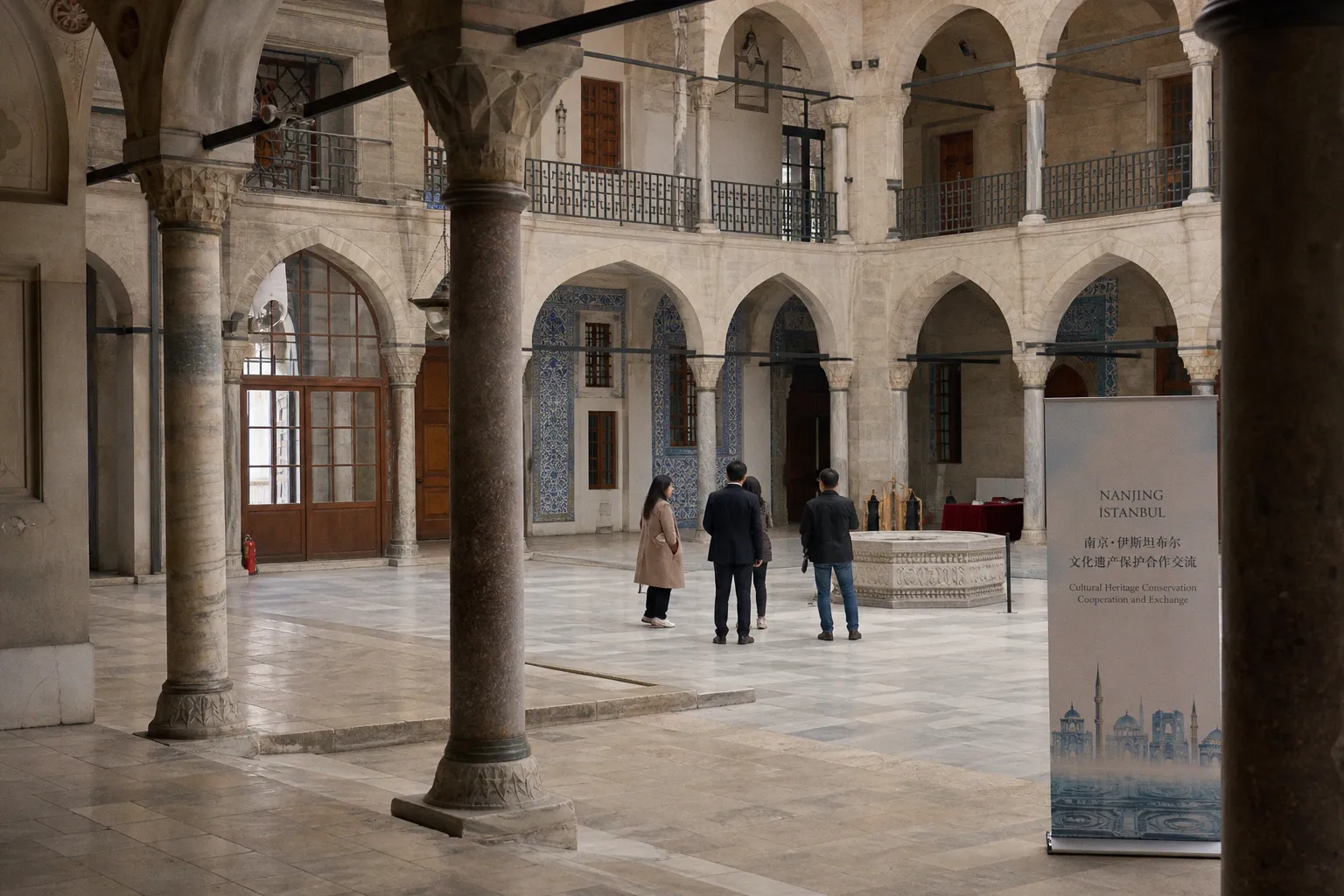
The “Nanjing-Istanbul Urban Civilization Dialogue” was held on Thursday and co-organized by China’s State Council Information Office and the Chinese Embassy in Ankara. Xinhua reports that it brought together more than 100 representatives from local governments, international organizations, academia, publishing, literary communities, and media.
The comparison is structurally coherent. Istanbul has ancient city walls built in the 5th century. They originally extended for about 22 km; restoration is continuing on the remaining 7.2-km section, according to Huriye Merve Gedik, head of the City History, Promotion and Tourism Department of the Istanbul Metropolitan Municipality. Nanjing’s 14th-century Ming Dynasty walls were presented as a counterpart, with the source describing them as among the longest surviving in the world.
This is not simply a diplomatic pairing of two old cities. Both places must manage heavy metropolitan growth around inherited defensive masonry. A wall is a load-bearing artifact, but also a boundary, a circulation edge, a tourist route, and often a repair problem. Conservation policy has to decide where stone, brick, mortar, drainage, vegetation, public access, and surrounding development sit in the hierarchy.
Living heritage, not only archaeological repair
Lu Andong, a professor at Nanjing University’s School of Architecture and Urban Planning, said the dialogue focused on how civilization is passed down and innovated through cities. He specifically pointed to living heritage, citing Istanbul’s Yedikule Bostans and Nanjing’s historic neighborhoods, and argued that this is as vital as archaeological engineering.
That distinction matters. Fortification repair can be reduced to masonry stabilization if the surrounding use is ignored. Old-town visitors often see only the cleaned surface: a restored gate, a repaired curtain wall, a curated walk. The more difficult work is spatial. Productive gardens, residential lanes, historic neighborhoods, and tourism flows all occupy the same conservation field.
Participants said Nanjing and Istanbul have different historical experiences but similar conservation tasks, and can benefit from exchanging practical solutions. Gedik described the meeting as a platform for sharing heritage conservation experience, adding that knowledge of each other’s architecture and history “nourishes both sides,” according to Xinhua.
What travelers should watch before planning around “restoration”
For old-town travel, the immediate implication is caution. Restoration does not automatically mean better access, better interpretation, or better preservation. In Istanbul, continuing work on the remaining 7.2 km of the walls may affect how routes along the fortifications function on the ground. In Nanjing, the Ming wall system remains a central conservation reference, but the relevant question is how it is connected to living districts rather than treated as isolated monument fabric.
The wider heritage sector is also under sharper scrutiny. Devdiscourse reported separately that Pakistan has faced criticism over conservation practices at Taxila, including concern over the use of modern materials and the possible risk of World Heritage in Danger listing. That case is not the same as the Nanjing-Istanbul dialogue, but it illustrates the technical standard now attached to conservation language: materials, authenticity, and method are no longer secondary details.
For readers planning heritage routes, the useful approach is therefore not to ask whether a city is “ancient,” but to check what is being repaired, who is managing the work, and whether living urban fabric remains part of the conservation plan. Nanjing and Istanbul are treating that question as a shared problem. The measurable results will be visible not in declarations, but in masonry joints, access routes, neighborhood continuity, and the restraint shown around historic walls.