New Greek Heritage Site Fire Rules Impacting Travel Plans
Greece has reportedly moved to consolidate fire protection rules across its network of archaeological sites, extending coverage to visitors and ancient landmarks under a climate-risk rationale.
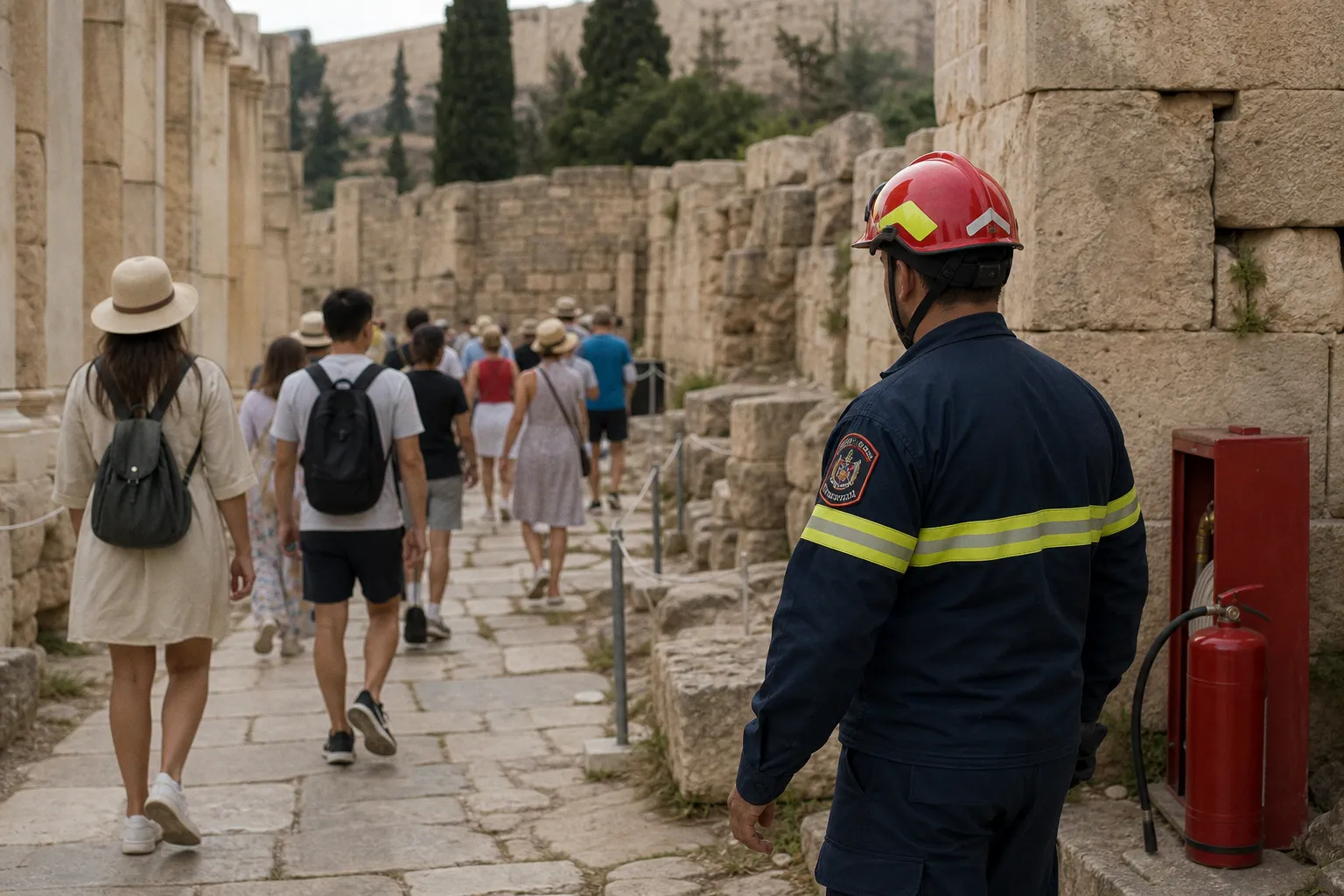
Scope of the reported measures
According to the headline-level reporting available, the new framework is framed as covering three categories: the archaeological sites themselves, the visitors moving through them, and the ancient landmarks at their core. The unifying driver is stated as climate risk — specifically wildfire exposure, which has affected Mediterranean heritage zones in recent years. The available reporting does not publish regulatory text, and the specific obligations attached to each category remain unspecified in the material reviewed.
Structural implications for masonry and open-air sites
From a preservation standpoint, the introduction of fire rules into archaeological site management is a structural problem as much as an operational one. Ancient masonry behaves predictably under thermal load: limestone and marble lose surface cohesion when subjected to sustained radiant heat, and vegetation rooted directly in substrate introduces a combustible interface with monument fabric. The reported framework's emphasis on shielding both sites and visitors implies that buffer-zone management will receive regulatory weight, with implications for how travelers approach sites on foot. Walking itineraries that pass through olive groves or pine stands adjacent to monuments may face seasonal rerouting, though the specific zones affected are not detailed in available reporting.
For related context, see Switch to Matter Hubs for Faster Local Smart Home Control.
For related context, see India International Travel Mart 2026: Industry Trends.
Practical verification before travel
Three checks remain prudent for visitors and operators planning summer or shoulder-season itineraries. First, confirmation with the relevant site authority on whether access hours or buffer-zone paths have been modified for the current fire-risk window — the reporting available does not specify whether changes are retrospective or forward-looking. Second, verification of ticketed entry points, since firefighting vehicle access frequently forces relocation of visitor gates at registered monuments. Third, local guide consultation on vegetation-clearance zones, which can affect both photography sightlines and the legibility of ancient walls from standard approach routes.
A separate front: UNESCO and the Middle East
UNESCO has separately expressed concern over the protection of cultural heritage sites amid escalating violence in the Middle East, following reported damage to the Golestan Palace in Tehran on 2 March from debris and shockwave after an airstrike in the site's buffer zone. The organization has communicated geographical coordinates of World Heritage and nationally significant sites to all parties concerned, recalling obligations under the 1954 Hague Convention for the Protection of Cultural Property in the Event of Armed Conflict and the 1972 Convention concerning the Protection of the World Cultural and Natural Heritage. For travelers, the practical effect is limited — but the parallel reporting reinforces that heritage protection in 2026 is operating across at least two distinct risk vectors: climate-driven fire exposure in the Mediterranean basin and armed conflict in the Middle East.