Compare Prague Old Town Audio Guides Before You Buy
A single ticket to the Astronomical Clock tower costs around 250 CZK, and roughly 4.2 million people pass through Old Town Square every year without understanding why the clock's calendar dial…
Compare Prague Old Town Audio Guides Before You Buy
A single ticket to the Astronomical Clock tower costs around 250 CZK, and roughly 4.2 million people pass through Old Town Square every year without understanding why the clock's calendar dial rotates counterclockwise or what the twelve medallions beneath it actually commemorate. That gap between looking and knowing is precisely what a well-made audio guide is supposed to close. But the market for Prague walking tours — apps, podcast-style downloads, GPS-triggered narrations, licensed guide recordings — has become so crowded that choosing the wrong one means spending three hours tethered to a narrative that either oversimplifies the Gothic and Baroque layers beneath your feet or, worse, fills the silence with folklore that no historian would endorse. Before we spend the money, let us understand what separates a genuinely useful tool from a pleasant-sounding distraction.
Prague's historic center was inscribed as a UNESCO World Heritage site in 1992, and the protected zone covers approximately 866 hectares — a footprint that includes the labyrinthine streets of Staré Město, the steep climb of Malá Strana, and the fortress walls of Hradčany. That scale alone is the first practical argument for audio guidance over aimless wandering: without a structured route, even experienced travelers miss Týn Courtyard or misread the Cubist facades on the House of the Black Madonna. Yet the same density that makes guidance essential also makes bad guidance particularly costly, both in time and in the erosion of historical understanding.
Navigating the UNESCO Labyrinth: Why GPS-Triggered Audio Matters
The medieval street grid of Prague's Old Town was never designed for pedestrians consulting a screen. Lanes bend where a Romanesque cellar wall once stood; a square opens where the Jewish ghetto was demolished in the late nineteenth century. For anyone relying on a narrated tour, the single most consequential technical distinction is between GPS-triggered playback and manual-play narration.
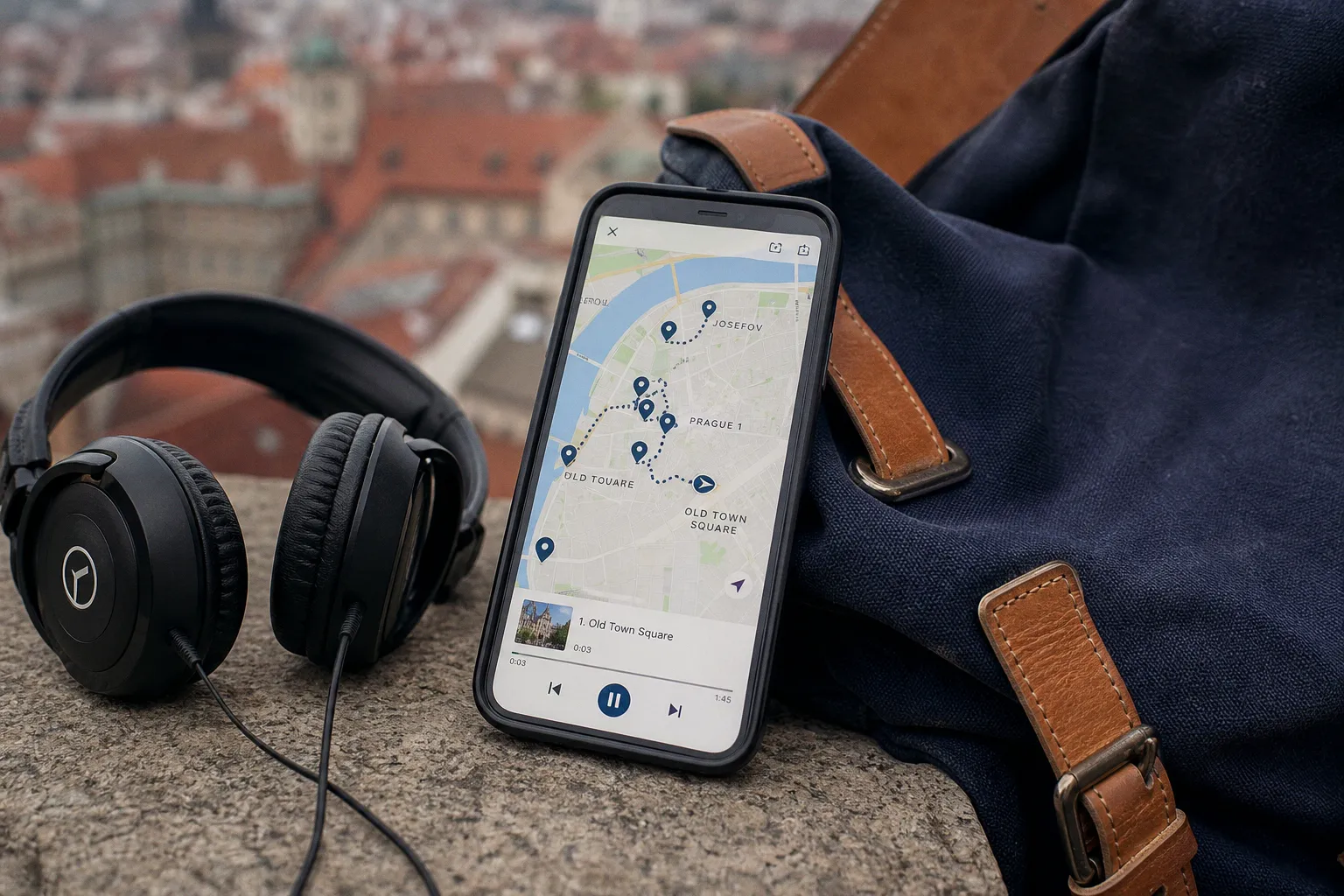
GPS-triggered guides use your phone's location to begin each audio segment automatically when you arrive at a specific coordinate. VoiceMap, one of the most established platforms for city audio tours, structures its Prague offerings this way: you reach the southern end of Charles Bridge, and the story of the statue groups begins without your tapping anything. The advantage is not merely convenience — it is orientation. In streets where sight lines terminate in church spires rather than boulevards, knowing that the narration has shifted because you have physically moved to the next waypoint is a form of navigation in itself.
Manual-play tours, by contrast, require you to tap a numbered stop on a list whenever you believe you have reached the right spot. Rick Steves' Europe audio app, which has offered a free Prague walk for years, operates this way. It works well if you already carry a printed map and can match the guide's written cues — "stand facing the statue of Jan Hus" — to your surroundings. But if you are uncertain whether the Baroque church to your left is the right one or the one a block over, manual playback gives you no corrective signal.
The practical difference between these two approaches is best understood through cost. A GPS-triggered system requires the tour creator to plot precise coordinates for every stop, test them in the field, and calibrate the geofence radius so the audio does not start too early (while you are still across the square) or too late (after you have already walked past). Manual-play is cheaper to produce, which partly explains why free tours tend to be manual and paid tours increasingly offer GPS triggering. For Prague specifically, the narrow streets of Josefov — the old Jewish Quarter — create GPS drift that even well-made apps struggle with. In those blocks, we recommend keeping a finger near the manual override regardless of which platform you choose.
| Feature | GPS-Triggered (e.g., VoiceMap) | Manual-Play (e.g., Rick Steves) | Integrated Platform (e.g., GetYourGuide app) |
|---|---|---|---|
| Automatic audio start | Yes, based on location | No, user-initiated | Varies by tour |
| Offline map included | Typically yes | Yes | Usually requires download |
| Typical price range | €8–15 per city | Free to €5 | €10–25, sometimes bundled with tickets |
| Historical depth | Varies widely by author | Consistently educational | Depends on partner operator |
| Best for | Self-paced walkers who want seamlessness | Budget-conscious travelers with a map | Visitors bundling tours with monument entry |
Evaluating Narrative Quality: Professional Historians vs. Fun-Fact Tours
Not all narration that mentions the year 1410 is telling you the same story. The quality spectrum for Prague audio guides runs from meticulously researched historical commentary to chatty collections of "did you know" tidbits that sound engaging but collapse under scrutiny.
The difference is not merely academic. When a guide tells you that the Old Town Square was once a thriving medieval marketplace, that is a defensible general statement. When a guide claims that the specific stones under your feet were laid by a particular guild in a particular year, that is a verifiable claim — and if it is wrong, you are now carrying misinformation through one of Europe's most historically layered cities.
Professional-grade guides tend to share certain markers. They cite periods rather than single dates for architectural phases — "late Gothic, roughly the 1370s through 1420s" rather than "built in 1381." They acknowledge what is uncertain: "historians debate whether the original Týn Church façade was completed before or after the Hussite wars." They reference the economic and political forces that shaped buildings, not just the aesthetic choices of architects. The best Prague audio tours, whether produced by licensed local historians or by platforms like VoiceMap that commission writers with specific expertise, treat the city as a living archive of Central European trade, religious conflict, and imperial ambition.
Fun-fact tours, by contrast, optimize for entertainment. They will tell you how many steps are in the Old Town Tower (187, for the record) and what legend is attached to the Golem of Prague, but they rarely explain why the Jewish Quarter was enclosed by walls, who paid for those walls, or what daily life was actually like inside them. The result is a tour that feels lively but leaves you with anecdotes rather than understanding.
A good audio guide does not make Prague easier to consume — it makes the city harder to misread.
We should be honest about the trade-off. Fun-fact tours are more popular because they demand less of the listener. Educational tours require attention, and they reward it with a fundamentally different experience of walking through a place. If you are choosing between the two, the question is not which is "better" in the abstract but which kind of memory you want to carry home.
Technical Essentials: Offline Maps and Data-Free Exploration
Prague's Old Town is dense with Wi-Fi signals, but connectivity is not the same as reliability. The narrowest streets in Josefov and the interior passages around the Clementinum create dead zones where a tour that depends on streaming will buffer, skip, or fail entirely. This is not a theoretical inconvenience — it is the reason offline functionality should be treated as a non-negotiable baseline, not a bonus feature.
Most established audio guide platforms now offer offline map downloads. VoiceMap allows you to download the entire tour package — audio files, map, and stop descriptions — before you leave your hotel. Rick Steves' app works in a similar fashion. The critical step, which many travelers skip, is downloading the content on a stable Wi-Fi connection before heading out. A 90-minute Prague audio tour with map data typically occupies 80–150 MB of storage, depending on audio quality and the number of map tiles included.
For those building their own walking itinerary rather than following a pre-made tour, open-source options deserve consideration. Maps.me and OsmAnd both provide detailed offline maps of Prague with pedestrian routing, and while they do not include narration, they offer a framework onto which you can layer your own research. The National Heritage Institute's publicly available architectural surveys, for instance, describe construction phases and restoration techniques for dozens of listed buildings in the Old Town — context that most packaged audio guides skip entirely because it does not fit a snappy narration format. When you pair those documents with a reliable offline map and walk the route yourself, you gain a dimension of understanding that no single pre-recorded tour can provide.
The practical checklist for technical readiness is short but worth following:
1. Download before departure. Every audio file, every map tile. Do this on hotel Wi-Fi, not on a roaming data plan that charges per megabyte.
2. Check battery life. A three-hour GPS-triggered tour with screen-on map display drains approximately 40–60 percent of a standard smartphone battery. Carry a small power bank.
3. Test the trigger radius. Before committing to a paid tour, read recent reviews that mention GPS accuracy in Prague specifically. Some global platforms calibrate their geofences for wide American boulevards, not for the compressed geometry of Central European streets.
4. Verify offline playback end-to-end. Some apps download maps but still require a data connection for audio licensing verification. This is the kind of detail that does not appear in the app store description but surfaces quickly in user reviews.
Verifying Historical Integrity in Third-Party Content
This is where most travelers lose the thread. Third-party audio guides — those produced by independent creators, travel bloggers, or platforms that commission narrators rather than historians — vary enormously in accuracy, and there is no reliable rating system that separates verified content from confident-sounding fabrication.
The CzechTourism official portal recommends licensed guides and specific cultural institutions for verified historical content. The distinction matters. A licensed Prague guide has passed an examination covering history, architecture, and cultural heritage law; a self-published audio tour creator has passed no such filter. This does not mean every licensed guide is brilliant or every independent tour is unreliable — it means the accountability structures are different, and as listeners, we should be aware of which structure produced the narration in our ears.
Practical methods for verification are accessible to any traveler with a smartphone. When an audio guide makes a specific claim — "this building was designed by Peter Parler in 1356" — a quick check against the Prague City Tourism database or the National Heritage Institute records will either confirm or flag it. More importantly, pay attention to what the guide does not say. If a tour walks you past the House at the Stone Bell without mentioning its Romanesque origins or the fourteenth-century reconstruction, that omission is itself a signal about the depth of the creator's knowledge.
The following markers suggest content that has been historically vetted rather than casually assembled:
- References to specific architectural periods with approximate date ranges, rather than single-year claims for buildings that evolved over decades
- Acknowledgment of restoration work and its dates, rather than implying that what you see is original medieval stonework
- Attribution of historical interpretation — "according to the National Gallery's records" or "as documented in the city's cadastral maps" — rather than anonymous assertions
- Inclusion of the Jewish Quarter's history beyond the Golem legend, covering the legal restrictions, the ghetto's dissolution, and the architectural legacy of the 1890s urban renewal
The absence of dates, sources, and caveats in an audio guide is not a sign of accessible writing — it is a sign of unchecked storytelling.
Balancing Flexibility and Structure in Your Old Town Itinerary
The best audio guide is the one that matches the way you actually walk. This sounds obvious, but the mismatch between a tour's assumed pace and a traveler's real pace is the single most common source of frustration — more common, in practice, than GPS glitches or audio quality complaints.
Pre-structured tours, whether GPS-triggered or manual-play, assume a walking speed and a dwell time at each stop. A typical Prague Old Town audio tour covers 1.5 to 3 hours and assumes you will spend three to five minutes at each narrated point of interest before moving on. If you are the kind of traveler who photographs architectural details for ten minutes or sits on a bench to absorb the atmosphere of a square, a rigid GPS-triggered tour will begin its next segment while you are still processing the previous one. Manual-play tours offer more flexibility here, because you control when each segment begins.
For travelers who want maximum control, a hybrid approach works well in Prague. Download a reliable offline map, load two or three short audio segments from different guides — one on Charles Bridge's statuary, one on the astronomical clock's mechanical history, one on the Jewish Quarter's urban development — and play each when you reach the relevant location. This requires more preparation than buying a single packaged tour, but it produces a more customized and historically layered experience. You are, in effect, curating your own soundtrack rather than accepting someone else's editorial choices about what matters.
The cost of this flexibility is narrative coherence. A single well-produced tour gives you a through-line — a story that connects the Old Town Square to the Powder Gate to the Municipal House and makes the walk feel like a unified experience rather than a series of stops. If narrative coherence matters to you, invest in a single high-quality paid tour rather than assembling fragments. If historical depth at specific points matters more, the fragment approach lets you go deeper than any single tour can.
One practical consideration that often gets overlooked: season and crowd density affect audio guide performance in ways that have nothing to do with the content itself. In July and August, when the Old Town Square is packed shoulder to shoulder, GPS-triggered audio that relies on your reaching a precise coordinate may activate while you are still half a block away, wedged between tour groups. During quieter months — November through February, excluding the Christmas market period — the same guide performs flawlessly because you can actually stand where the creator intended you to stand. This is not a flaw in the technology; it is a reminder that the physical context of your walk shapes the quality of your experience as much as the narration does.
What we are really choosing, when we compare audio guides for Prague's Old Town, is not a product. We are choosing how much of the city's eight centuries of accumulated meaning we are willing to engage with, and how much we are willing to let pass beneath the narration. The 866 hectares of the UNESCO zone contain layers of Romanesque foundation, Gothic vaulting, Baroque façade, Art Nouveau ironwork, and Communist-era concrete, all pressed into the same block. No single audio guide can give us all of it. But the right one — technically reliable, historically honest, paced to our walking speed — can make sure that what we do hear is worth carrying home.