Egypt unveils intact Byzantine city and ancient tombs
A fourth-century CE settlement in Egypt's Dakhla Oasis has emerged from excavation with its grid street plan, central basilica, defensive towers, and vaulted residential blocks reportedly intact.
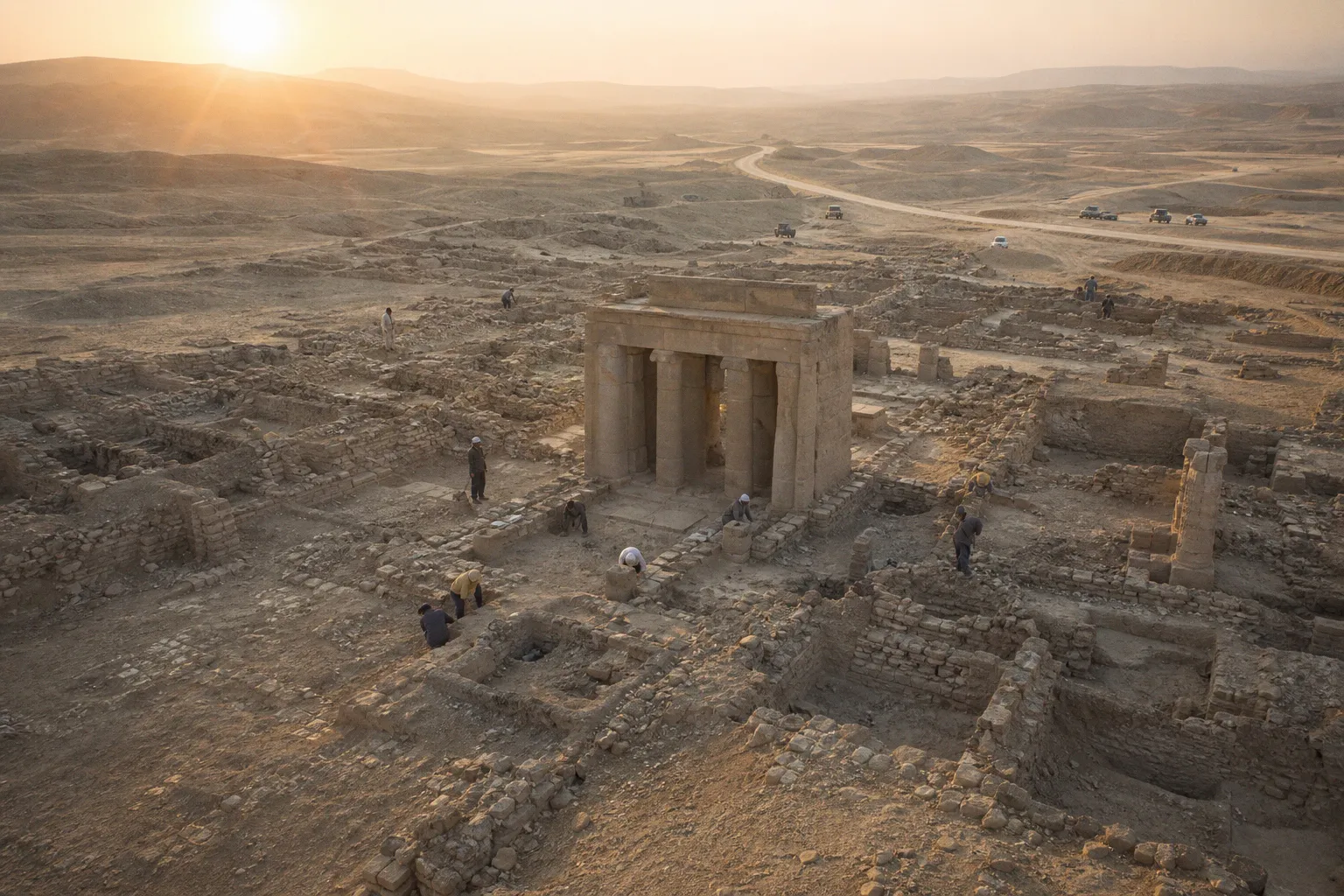
Grid Layout and Load Distribution at Dakhla
The settlement's structural record follows documented Byzantine urban-design conventions. North–south axes intersect east–west routes, producing defined blocks, open squares, and designated communal zones — a layout consistent with administrative centralization rather than incremental vernacular growth. The basilica occupies the physical and visual center of the plan, sited to overlook the principal thoroughfares; its footprint indicates a load-bearing masonry core with adjoining ancillary spaces. Defensive towers positioned at the perimeter outline a deliberate security envelope, not an ad hoc response to threat.
Residential structures display vaulted construction and reception halls sized for communal function. One building has been provisionally identified as an early ecclesiastical residence — a domestic worship space predating the basilica proper. Recovered domestic assemblages — bread ovens, grinding tools, kitchen installations, food-preparation areas — confirm a self-contained local production economy rather than one dependent on long-distance supply. Together, the remains yield a near-complete spatial hierarchy: ceremonial core, administrative axes, defensive perimeter, domestic interior.
Coastal Tombs and the Epigraphic Layer
Near Alexandria, archaeologists have documented an ancient coastal tomb network whose precise extent remains to be published in detail. A separate report dated 9 July 2026 references 200 inscribed ceramic shards from related excavations, supplying an epigraphic record of daily activity. The shards, paired with the basilica and the residential archaeology at Dakhla, add a documentary dimension to the structural one — useful for cross-dating construction phases and for interpreting space use within the settlement. For visitors, the inscription corpus is also the first published layer likely to appear in any future on-site interpretation.
Planning Implications for Heritage Visitors
Egyptian authorities frame both finds within a national strategy positioning cultural tourism as an economic pillar. Travelers assembling preservation-focused itineraries should treat the announcements accordingly: as signals of forthcoming site-management decisions, not as immediate additions to walkable circuits. Several items require confirmation before any itinerary adjustment — public access terms at Dakhla, the formal protection status assigned to the Alexandria tomb network, the presence of on-site interpretation, and the seasonal schedule for licensed guided visits. Sites under active excavation typically restrict movement to controlled zones, and a structurally intact Byzantine settlement will not be casually walkable in the short term. Multi-site travelers mapping routes through the Western Desert or the Mediterranean coast should monitor official site listings and licensed-guide requirements rather than rely on third-party operators until access terms are formally published.