Preserving Registered Cultural Heritage and Surrounding Areas Together
In 2002, the Svalbard Environmental Protection Act extended automatic cultural heritage status to every structure on the archipelago dating from before 1946.
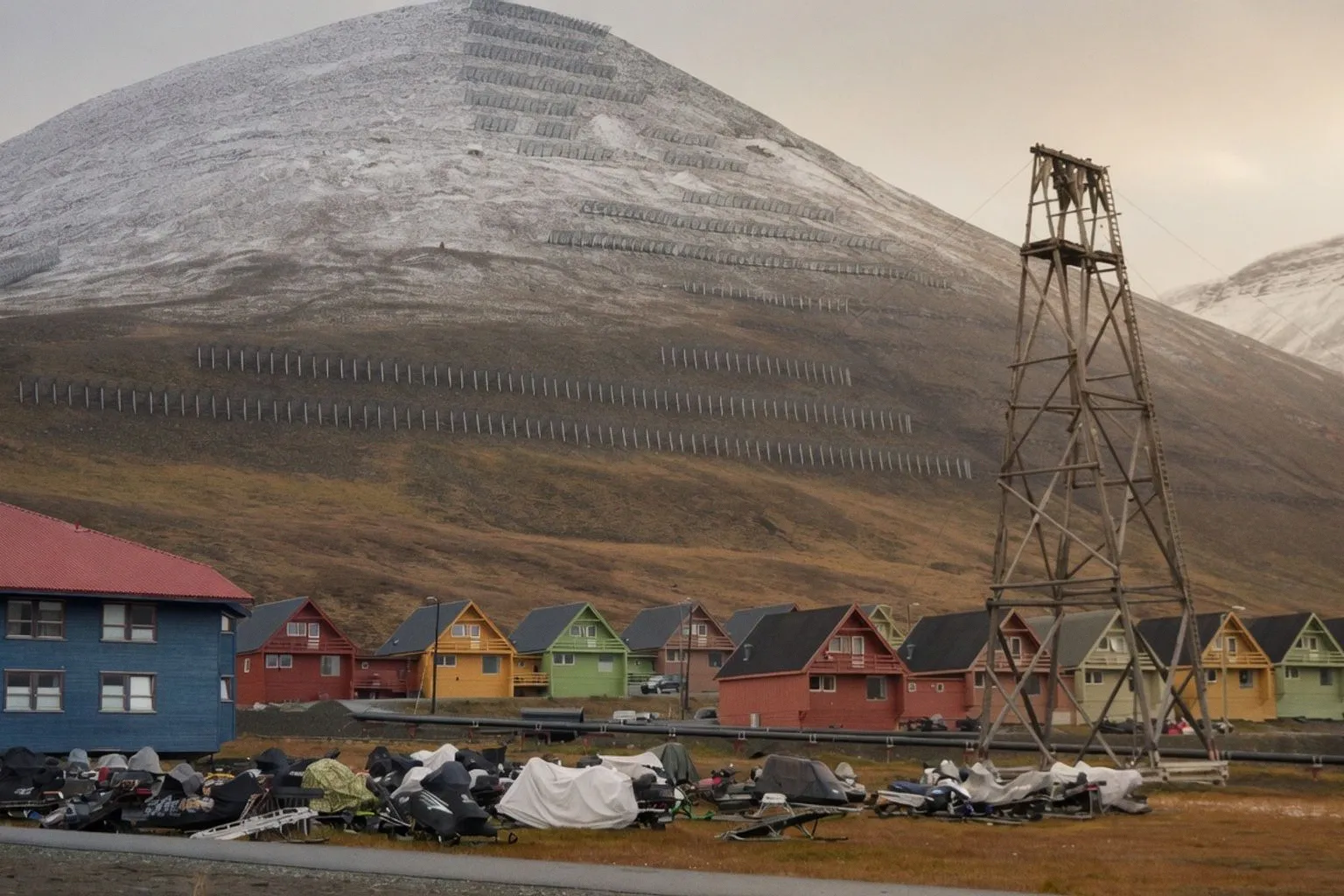
A foundation sized to a finite operating life
The cableway pylons were founded on untreated wooden posts set directly into permafrost. The posts relied on frozen ground for both lateral and vertical stability — a standard solution for Arctic industrial construction whose service life was tied to active mining. As project coordinator Gry Alfredsen of NIBIO stated, the structures were never dimensioned for permanence: they were built to serve only as long as the mines provided coal.
When mining ended, the structures remained in place. The 2002 act converted them from obsolete infrastructure to protected heritage, transferring the maintenance obligation from industry to public stewardship without modifying the underlying foundation logic. The posts now require the very ground conditions — stable, continuously frozen soil — that regional climate trends are steadily removing.
Four vulnerability factors, sampled at base and beam
Project researchers assessed the pylons using small surface samples (2 × 2 × 5 cm) taken at near-ground level and at approximately breast height on horizontal beams. The sampling protocol combined visual inspection, thin-bit drilling to gauge internal decay, microscopy, chemical analysis, and DNA metabarcoding of fungal communities. Four vulnerability factors emerged across Svalbard and the project's secondary site at Finse on Hardangervidda:
- Public understanding of which on-site features constitute heritage
- Documented condition of the structure
- Physical fragility of the constituent materials
- Patterns of use, including tourism footfall
The soil–air transition zone registers as the primary failure point. Rot concentrates where the wooden posts meet the atmosphere, and permafrost thaw now deepens on an annual basis, undermining lateral support. Longer, warmer, and wetter seasons extend the active period for wood-decaying fungi.
Tourism as an unmodeled load variable
Anne-Cathrine Flyen, a technical conservation specialist at the Norwegian Institute for Cultural Heritage Research, identified the central operational problem: visitors and their guides frequently cannot read the sites as heritage. Wooden remnants that conservation training interprets as historically significant register to most tourists as loose planks or surface debris. Foot traffic follows, on structures never dimensioned for pedestrian load. Guides tend to focus on historical narrative rather than material vulnerability, and simple mitigation measures — improved signage, low-profile barriers — are inconsistently deployed.
A transferable methodology for other historic quarters
The Svalbard assessment isolates a failure pattern with wider applicability. A protected designation does not retroactively alter a structure's structural system. When a legal framework converts industrial ephemera into heritage, the original load assumptions, material specifications, and foundation logic remain unchanged, while the maintenance mandate expands. For historic wooden settlements facing analogous conditions — permafrost-adjacent towns, alpine stations, coastal quarters on timber piles — the ArcticAlpineDecay baseline offers a replicable protocol: sample at the soil–air interface, document internal decay through minimally invasive drilling, and pair structural assessment with visitor-use data.
The project's next phase, according to researchers, will test whether low-cost interventions can reduce the tourism load variable without restricting site access. For travelers and heritage managers tracking comparable sites, the signal is structural rather than atmospheric: the engineering did not change when the legal status did.