Preserving 4,000 Years of Agriculture: Inside Tucson’s Mission Garden
According to Pima County, Tucson’s Mission Garden has received formal recognition for its national historical significance.
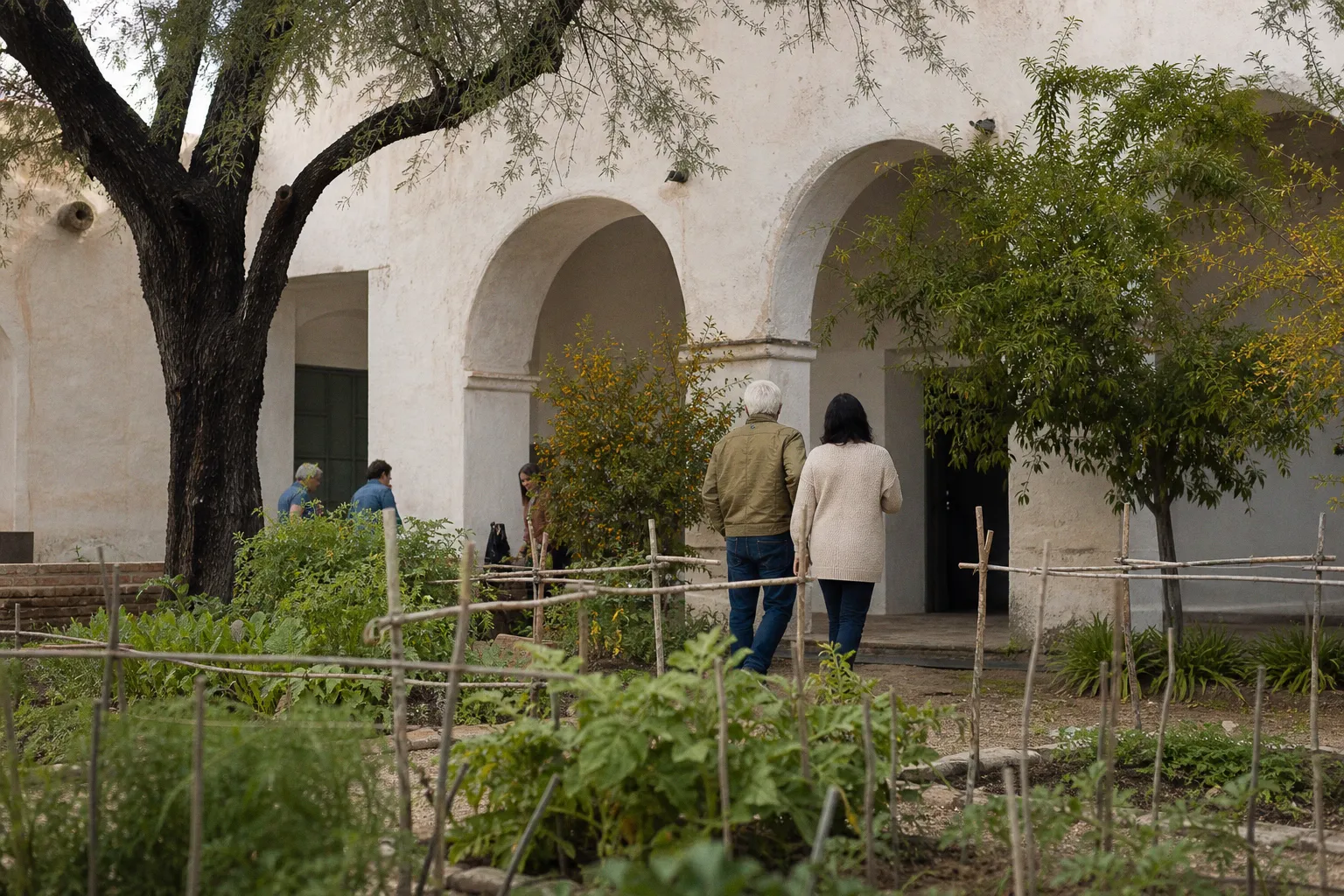
The designation concerns a cultivated landscape rather than a single monument: the site records 4,000 years of continuous agriculture in the Santa Cruz River valley. For visitors to historic districts, that distinction matters. The surviving significance lies in land use, water management and reconstructed boundaries as much as in visible masonry.
A garden is not an ornamental remnant
Mission Garden should be read as an agricultural site with a long occupational sequence. Pima County’s description places its value in the continuity of cultivation across four millennia, not in a claim that every physical component is original to one period.
That is a necessary correction to the usual heritage-travel shorthand. Historic places are often treated as fixed architectural objects: walls, façades and date plaques. Here, the heritage record is spatial and operational. The Santa Cruz River valley provides the geographic frame; cultivated ground and irrigation provide the working structure.
A visit therefore requires attention to the site’s layout rather than a search for an untouched historical scene. Planting areas, water routes and enclosing walls are part of the interpretation. They describe how a landscape was organised and maintained over time.
Reconstruction and irrigation are separate preservation questions
Recent work included the recreation of 17th-century mission walls and upgrades to irrigation intended to preserve heirloom crops. These are materially different interventions and should not be conflated.
The recreated walls are a reconstruction: new fabric used to make a historical boundary legible. Their value is interpretive and spatial. They establish the perimeter and hierarchy associated with the mission-period garden, but they are not evidence that the present masonry has survived unchanged from the 17th century.
The irrigation work addresses a different condition. Agriculture cannot be preserved through masonry conservation alone. Water distribution is an active system, and the continued cultivation of heirloom crops depends on its maintenance. In this case, retrofitting infrastructure is not an ancillary upgrade; it is part of the site’s preservation logic.
For readers planning a visit, the relevant question is not whether the garden presents an unaltered historic fabric. It does not claim to do so in the reported description. The more useful question is whether the interventions clarify the historical landscape without obscuring their own modern role. Pima County’s account identifies both the recreated walls and the upgraded irrigation, allowing that distinction to remain visible.
What the recognition changes for interpretation
Formal recognition establishes national historical significance, but it does not reduce the garden to a static exhibit. Its central subject remains continuity: cultivation in the Santa Cruz River valley across a stated 4,000-year period.
That makes Mission Garden particularly relevant to the study of historic urban edges and river-valley settlements. In many old towns, agricultural systems were later displaced by streets, building plots and utility corridors. At this site, cultivation remains the interpretive medium. The physical record is maintained through use, including irrigation and crop care, rather than sealed behind a barrier.
The preservation problem is consequently practical. Masonry requires compatible maintenance; planted material requires seasonal care; irrigation requires functioning infrastructure. The site’s significance depends on keeping these layers intelligible without presenting reconstruction as original surviving fabric. Pima County’s recent work indicates that the garden is being managed on those terms.