Hanoi’s Heritage Preservation Plans: Why Administrative Pledges Need Technical Proof
According to VOV.VN, Hanoi is stepping up international cooperation in cultural heritage preservation. The available report provides no project list, funding figures, partner institutions or site-specific conservation scope.
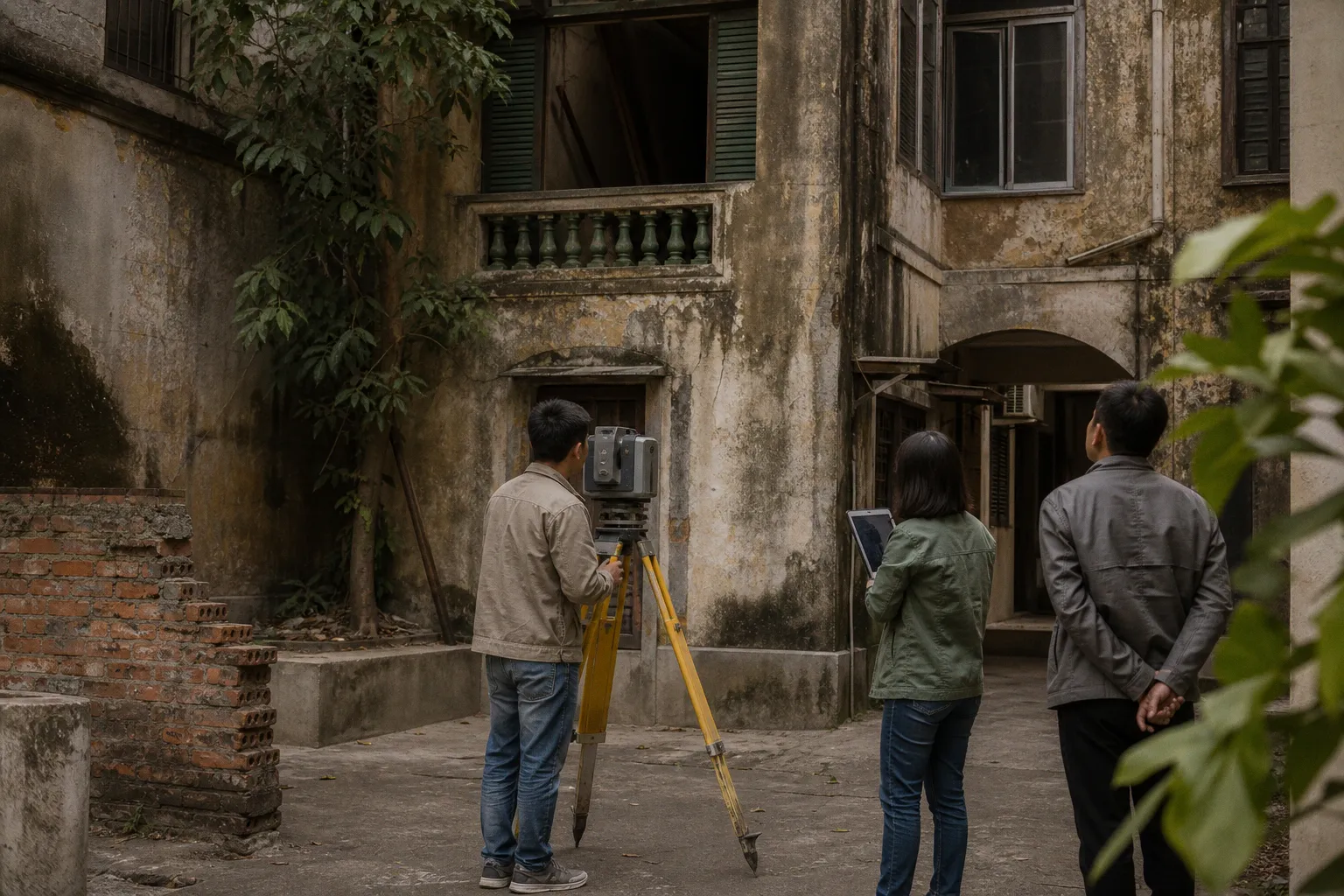
For historic-quarter observers, that absence is material: “cooperation” is an administrative framework, not evidence that a masonry structure, street frontage or traditional spatial pattern has yet been secured.
A preservation announcement without a technical schedule
The VOV.VN item establishes the direction of policy but not its physical consequences. No confirmed detail identifies whether the cooperation concerns survey work, restoration standards, training, documentation, adaptive reuse or management controls.
Those distinctions determine the value of any heritage programme. A condition survey records defects and material loss. A conservation plan sets intervention limits. Retrofitting alters the performance of an existing building. Urban management regulates the relation between individual plots, lanes, public space and new construction. These are not interchangeable activities, and the report presently does not indicate which, if any, are included in Hanoi’s international work.
Visitors should therefore avoid reading the announcement as a claim that particular historic areas are newly protected, accessible or stabilised. There is no confirmed information on boundaries, building inventories, access arrangements, or the treatment of occupied properties.
What needs verification at street level
For a historic town, international participation becomes meaningful only when it can be traced to a defined urban fabric. The necessary questions are basic: which district or building type is under consideration; what period of construction is being documented; whether original load-bearing walls, timber elements, roof structures and mortar finishes will be retained; and how later alterations will be assessed.
Equally important is the administrative layer. Heritage work can preserve an individual façade while leaving the surrounding spatial hierarchy vulnerable to redevelopment, traffic pressure or incompatible additions. Conversely, strict zoning without maintenance provisions can leave historic fabric intact on paper and deteriorating in practice.
None of these outcomes can be inferred from the VOV.VN headline alone. The announcement should be treated as an opening position rather than a completed preservation measure.
Digital records are not the same as conservation
The wider news cycle shows how broadly the term preservation is now applied. A separate report says Tencent is deploying AI and gaming technology to digitally preserve Jingdezhen’s newly crowned UNESCO porcelain heritage. Another says UNESCO has highlighted Uzbekistan’s commitment to cultural heritage preservation and modernist architectural sites in Tashkent. These are distinct cases, with no stated operational connection to Hanoi.
The distinction matters. A digital record can assist documentation and interpretation, but it does not repair masonry, resolve water ingress, or regulate incompatible construction. Questions about the ownership and governance of virtual heritage records also differ from the conservation of a physical townscape; the contrast is useful when considering centralized and decentralized metaverse architectures.
For Hanoi, the next substantive evidence would be a named programme, identified international counterparts, a geographical scope and a published account of the physical heritage to be conserved. Until then, the announcement signals intent, not a measurable alteration to the city’s historic fabric.