Bologna Food Tour: Navigating the Quadrilatero Markets
The Quadrilatero in Bologna arrives with a confident sales pitch: a medieval market district where every cobblestone still remembers the salt tax and the pork barrel.
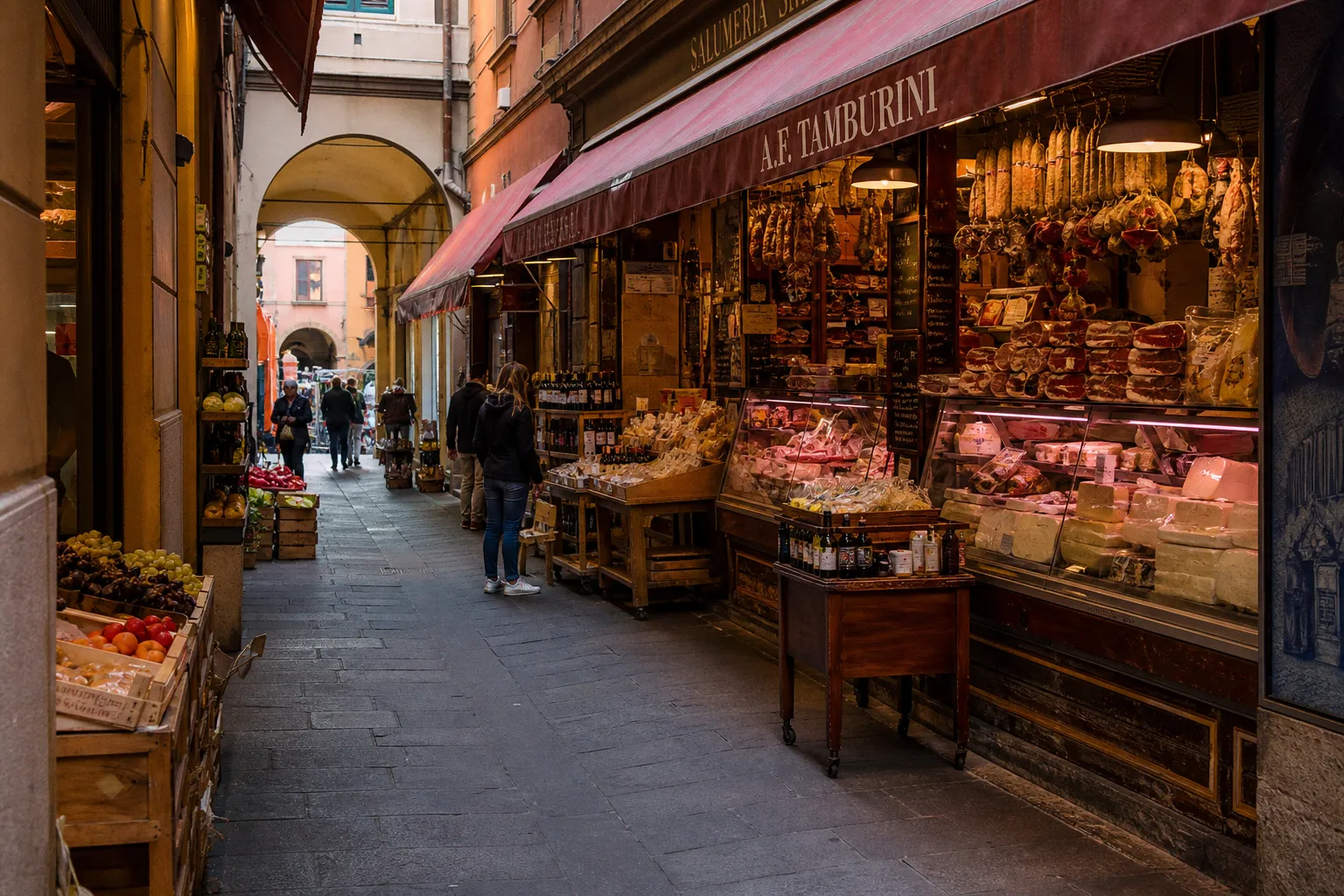
I have walked the Quadrilatero on three separate visits in the last four years, generally with a notebook in one hand and a small bread roll in the other. My notes have gotten longer, not shorter. The district remains Bologna's most legible culinary inheritance — but it is also a heritage product that has been partially retrofit, partially corporatized, and partially held together by a handful of family shops clinging to leases negotiated in 1932. A self-guided bologna food tour in this part of the city is therefore an exercise in separating the green-and-gold PGI signs from the laminated souvenir menus.
The Quadrilatero is no museum. It is a functioning retail district that has been retrofitted so many times that its "medieval" character is partly performative, partly structural, partly an honest inheritance.
The Medieval Roots: What's Actually Original
The Quadrilatero's grid is real, and it is genuinely old. Historical records trace commercial traffic in what is now the market district back to the Roman era, when Bologna was a road town with the predictable appetite for salted pork and milled grain. The current layout — a tight rectangle of narrow streets bounded roughly by Piazza Maggiore, Via Rizzoli, Via Clavature, and Via delle Pescherie — settled into its modern footprint during the Middle Ages, when the city was a Commune rich enough to fight the Holy Roman Emperor and to argue, repeatedly, with the Pope.
What that means for a visitor is straightforward: the street pattern one walks through in 2024 is not a heritage-styling exercise. The Via Pescherie Vecchie still runs where fishmongers once carried eels down to the old river port. The Via degli Orefici still holds the goldsmiths, even if a few of them are now piercing cartilage instead of setting stones. The bones of the district are medieval bones.
The fascia over those bones is something else. Walk the same streets and you find a neighborhood in slow, continuous retrofit: stone lintels patched with steel beams, ground-floor shopfronts rebuilt every twenty years, upper floors converted from artisans' workshops to short-term rentals. The upside is a living quarter, not a theme park. The downside, for anyone expecting a frozen tableau, is that "authentic medieval" is a claim, not a description. Visitors who arrive imagining unbroken continuity are quietly disappointed; visitors who arrive expecting to read the layering — Roman foundation, medieval plan, modernized skin — get a much better deal.
Decoding PGI: Mortadella Bologna and the Limits of Certification
No product of the Quadrilatero is more heavily marketed than Mortadella Bologna. The signs are everywhere: green-and-gold PGI shields on deli windows, color-printed placards in bakeries, full-window decals at airport-adjacent vendors. The branding does its job.
What the PGI seal actually guarantees, and what it does not, is where the auditor's work begins.
PGI, or Protected Geographical Indication, certifies that a product has a defined geographic origin and at least one stage of production — sometimes just one — taking place in that region. For Mortadella Bologna PGI, the Consorzio Mortadella Bologna enforces production regulations covering the cut of pork (shoulder, ham, belly, choice trimmings, no offal), the seasoning (salt, pepper, optional spices), the casing (natural beef bladder or other natural casing), the cooking process (steam or dry heat to a minimum internal temperature), and the final size and weight rules. The seal on a deli window means the supplier has signed up to those rules. It does not mean the supplier is small, old, or particularly skillful.
What this means at the counter, in practical terms, is that there are essentially three tiers of mortadella on offer in the Quadrilatero. Top tier: a deli or restaurant that slices to order from a freshly hung casing, sold by weight, with a visible production batch stamp and a knowledgeable person behind the counter. Middle tier: pre-sliced vacuum packs of certified PGI mortadella from a recognized regional producer, properly stored, with no obvious rebranding sleight-of-hand. Bottom tier: the cylinder in the window with a PGI sticker, the counter assistant who cannot name the producer, the price point that suggests a filler-heavy industrial blend stretching the regulations.
Avoid the bottom tier. It is not unsafe; it is just not what the marketing is selling.
| Where You See It | What to Ask For | What Tells You It's Real |
|---|---|---|
| Whole hanging casings, cut to order | Producer name, batch date | Visible batch stamp, slice on demand |
| Vacuum-sealed sliced, refrigerated | Producer label, PGI code | Named regional producer on the pack |
| Counter-sliced from a cylinder | Producer name, recent batch date | Counter assistant can name the supplier |
| Pre-sliced on platter, ambient | Origin town, batch label | Pack open less than an hour, named source |
The Quadrilatero hosts all four. A well-built bologna culinary tour should walk straight past the ambient souk-style displays. The certifications on the wall do not save a product that has been sitting under a heat lamp.
Mercato di Mezzo: Restoration, or Just Renovation?
The Mercato di Mezzo, sitting at the heart of the Quadrilatero, is the district's most contested heritage asset. It was historically Bologna's central food market, the place where the city did its serious shopping for centuries. By the early 2010s, after decades of declining footfall and a brief stint as a partially occupied food court, it had the unlovely look of a building whose function had been outgrown.
The 2014 reopening was sold as a return to the building's original purpose. Three levels, internal courtyards restored, stalls let at preferential rates to tenants selling food. It is now a busy place, particularly at aperitivo hour, and it does deliver one useful function for visitors: a single, weatherproof building where you can sample tortellino, mortadella, tigelle, and a passable spritz under one roof.
However. A 2014 restoration of a medieval market building is not a medieval market. The current operator has applied a contemporary hospitality overlay — central seating, branded lighting, a 9 p.m. closing time unheard of in the actual historic market — that places it somewhere between an Italian gourmet mall and a serviceable food hall. It is the right place to take someone who has just arrived in Bologna and is hungry and tired. It is not the right place to take someone looking for a 1932 deli experience.
The most useful framing is to treat the Mercato di Mezzo as a restored shell housing a modern operation. The brick vaulting is real. The historical signage on the upper façade is real. The foot traffic inside is a planning department's reading of "Bologna food district," not an inheritance from the Middle Ages. Whether that is restoration or renovation is partly a question of intent, partly of structural fidelity. On both counts, this building reads closer to honest renovation than to dishonest heritage theater. Just know that you are paying for the price point and the convenience, not for an unbroken hand-off from the medieval guilds.
The Mercato di Mezzo is a working renovation of a working building. The vintage brickwork does the heavy lifting; the rented stalls do the rest.
The Tortellino, the 1974 Recipe, and What "Authentic" Actually Means
The Quadrilatero is also a useful place to begin to understand the city's pasta — and to set straight one of the more stubborn pieces of culinary mythology in town.
The official recipe for the filling of Tortellino Bolognese was registered with the Bologna Chamber of Commerce in 1974. That year is worth pausing over. It is not, by any stretch, an "ancient recipe." It is a codified recipe — a written, notarial record of a filling that the city's pasta makers had been making for centuries. Most food writers do not make this distinction; many brochures do not bother to make it at all. The 1974 record is the public version, not the entire history.
What the codification does, however, is fix a starting point for what is honestly dissectable. Mortadella, prosciutto, pork loin, Parmigiano Reggiano, egg, nutmeg, pepper. The ratios vary between households, but the ingredients do not — and that much a serious food tour of Bologna can verify. Walk into a Quadrilatero pasta shop and ask for the filling list. If the answer starts enumerating herbs, cream, ricotta, or any kind of béchamel, you are not in Bologna.
The same logic applies, with more force, to fresh tagliatelle, which the official ratio sets at one egg yolk per hundred grams of flour, with whole eggs added depending on richness. Some shops go richer, some leaner, but the shop that cannot quote you a sensible egg-to-flour ratio at the counter — that is, cannot quote you any ratio — is a shop where the pasta is being bought in from a regional wholesaler and cut on site. Plenty of those exist in the Quadrilatero. They are not unethical; they are just not pasta shops, however their window decals read.
A small, useful chart for the ask-at-the-counter moment:
| Dish | What the Tradition Actually Fixes | Common Marketing Add-On |
|---|---|---|
| Tortellino filling | Mortadella, prosciutto, pork loin, Parmigiano, egg, nutmeg | Cream, ricotta, herbs beyond nutmeg |
| Tagliatelle | Egg-to-flour ratio codified; rich yolk-based dough marketed as standard | "Bronze die" sold as the headline claim |
| Mortadella Bologna PGI | Cuts, spices, cooking method regulated | "Hand-tied," "farmhouse," or "artisanal" with no producer |
| Ragù alla Bolognese | Slow-cooked meat and soffritto tradition; recipes vary meaningfully by household | Tomato-heavy, "Sunday gravy" style adaptations |
The point of this chart is not to gatekeep the dish. It is to give a visitor a tool. A self-guided bologna food tour gets much more interesting when you stop eating on autopilot and start asking the counter which version of the local canon you are actually being served.
Curating the Route: Five Stops That Earn Their Footprint
A practical food tour of Bologna is best built around stops that pass three tests: family ownership or long-standing identity, a working production footprint (a counter, a kitchen, a visible supply chain), and product that is genuinely of the district.
Tamburini deserves the opening slot. Founded in 1932, sitting on the edge of the Quadrilatero, it is one of the few shops in the district that has not been bought and resold in a generation. The counter still does its own slicing, the back room is still a working laboratory for cured meats and pasta sauces, and the front room is a usable, not theatrical, retail space. It is not cheap. Nothing on this list is cheap. The trade-off is that what you are paying for is verifiable, and the rest of the route can be calibrated against it.
The second stop should be one of the historic fresh-pasta shops along Via Clavature or Via delle Pescherie. The good ones cut egg pasta fresh in the window; the indifferent ones sell pasta made elsewhere and shaped on site. The auditor's trick is to ask which supplier delivers the dough. An honest shop will name them. The reliable shops — and there are several — make their own dough in view of the counter.
Third stop, a working bakery for tigelle and crescentine. Tigelle, the small round flatbreads traditionally cooked in a clay tigelliera pan, are one of the more honest street foods in the city because they are essentially impossible to fake convincingly in industrial dough. A bakery making them on premises, with a working tigelliera in view, is a much better bet than the places that sell them pre-baked from a warming drawer.
Fourth stop, a wine-and-cheese bar with an actual cellar — preferably one run by a person who can tell you the difference between a Pignoletto frizzante and a Lambrusco without checking the bottle. The Quadrilatero has a handful. They are easy to find, easier to book, and the markup on a glass of regional wine is the cleanest read on a restaurant's honesty you can get.
The fifth stop, and the one I would argue is non-negotiable, is a sit-down lunch at a trattoria that is open only at lunch, has no printed menu in three languages, and has a queue. Bologna's serious trattorias do not advertise. They open at twelve, they are full by half past, and they close at two. They are not bookable online. This is the part of a self-guided bologna food tour that the guidebooks universally under-explain, because guidebooks cannot sell what is not listed.
The Verdict
The Quadrilatero is a good place to take a hungry, curious visitor to Bologna. It is not the place to take someone who has come for a sanitized heritage diorama, because the district does not offer one. What it does offer is a functioning medieval grid overlaid with a robust modern food retail operation, a handful of genuinely old shops, a useful market hall rebuilt for the 21st-century tourist, and a tangle of PGI certifications that reward inspection rather than trust.
The best food tour in bologna italy is the one you build yourself, with a budget that respects what PGI actually costs, a notebook that writes down what the counter actually said, and a willingness to walk past three tourist-facing displays for every one that is worth the price of admission. Bologna's culinary inheritance has survived a thousand years of one-off retrofits. It will survive this one. The visitor's job is to figure out which parts of it are actually old and which parts are simply consistent.