Medieval towns in Europe: what remains authentic today
When we step into the old quarter of Carcassonne, we are walking through one of the most thoroughly preserved—and most thoroughly remade—medieval towns in Europe.
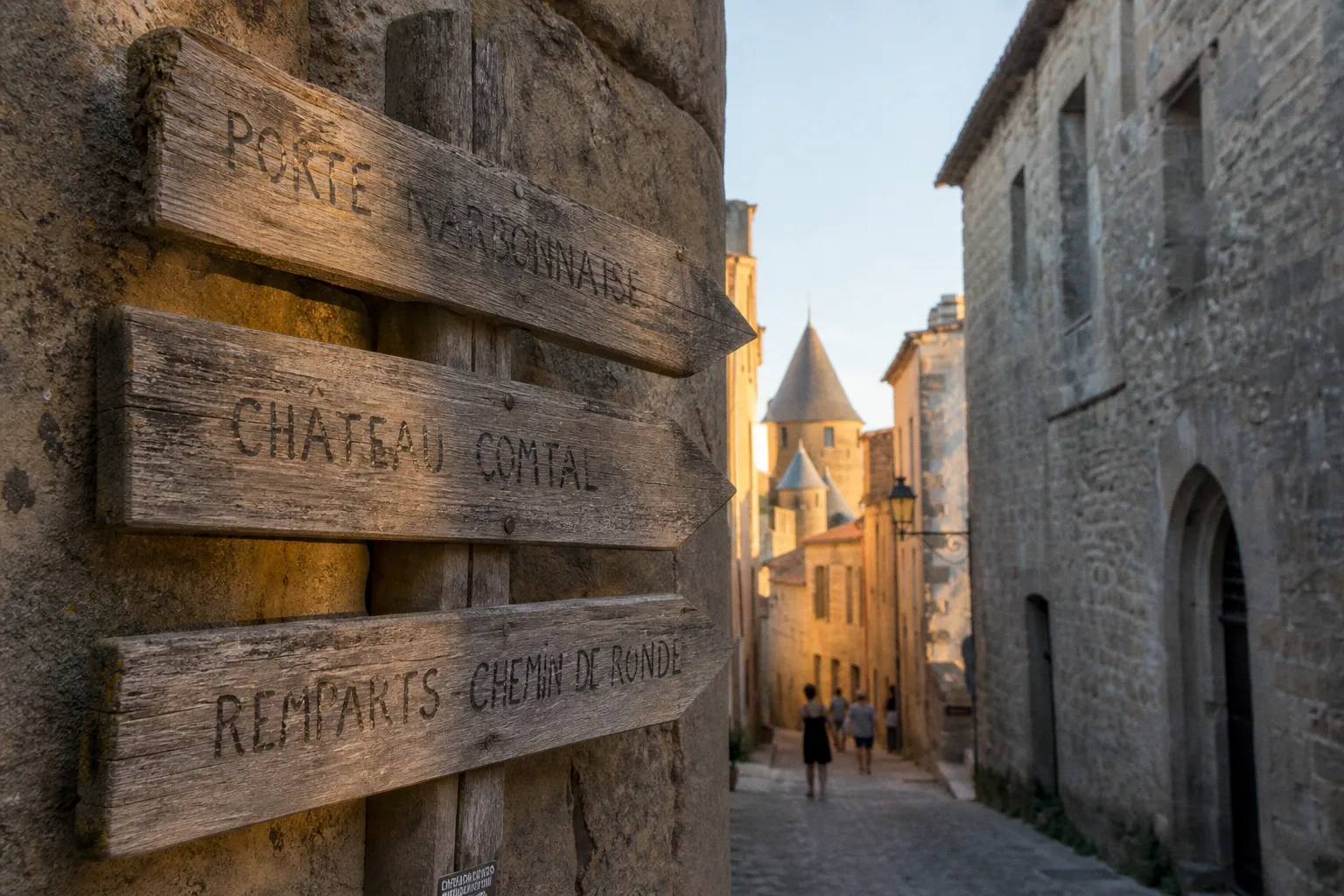
This is the conversation we ought to have before booking a heritage itinerary: not which town looks the most medieval, but which town contains the most medieval substance.
Reading the Street Plan Before You Read the Stones
The most reliable indicator of medieval authenticity is not a single building but the urban morphology—the pattern of streets, plots, and public space. Medieval towns grew incrementally, often within the constraint of a defensive circuit, and they did so without the benefit of modern surveying. The result is a network of narrow, winding streets that follow topography rather than grids, with irregular plots that grew organically around wells, marketplaces, and parish churches.
We have walked the old quarters of towns across France, Italy, Germany, the Czech lands, and Belgium, and the constant is this: where the street plan survives intact, the town tends to feel medieval even where individual facades have been renewed. The reverse is also true. A town can hold a number of restored Gothic buildings and still feel like a nineteenth-century city if its streets have been straightened, widened, or punched through with new axes.
Three morphological features, in particular, are worth tracing on a map before arrival:
- Irregular street widths and curved alignments. Roman grids and modern planning impose geometric regularity; medieval layouts hug the land.
- Narrow, gated access points. Even where town walls are gone, the historic approach often retains the pinch-points where gates once stood—now marked by archways, towers, or simply by abrupt changes in building line.
- A central market square that does not lie at the geometric center. The medieval market was placed where trade routes converged, not where a town planner's compass pointed.
The street plan is the autobiography of a town. A facade can be remade; a street network cannot be erased without erasing the town itself.
Restoration, Reconstruction, and the Romantic Imagination
The question of authenticity becomes sharper in the nineteenth century. Across Europe, the Gothic Revival movement—driven by antiquarian scholarship, nationalist sentiment, and a desire to attract visitors—produced some of the most consequential restoration campaigns in architectural history. Carcassonne is the most cited case, but it is far from the only one.
Viollet-le-Duc worked on Carcassonne from 1844 until his death in 1879, and his interventions were substantial. He rebuilt the roofs of the towers in slate, added the distinctive pepperpot turrets, restored portions of the inner ramparts, and consolidated the walls. He did so according to a coherent theory of "stylistic unity"—the idea that a medieval building should be completed in its own idiom, even where historical evidence was absent or ambiguous. The work was admired at the time and remains admired today, but it is also a textbook case in the ethics of intervention.
The principles that now govern such work were not codified until 1964, when the Venice Charter established the international standard for conservation. The charter's central tenet—that new work must be distinguishable from the original, and that any restoration should respect the document of the past rather than impose a conjectural whole—was a direct response to the Viollet-le-Duc school of thought. Two of its clauses deserve quoting in spirit: a restored site must preserve the setting in which its authenticity derives, and any new material must bear a visible stamp of its own date.
What we call "restoration" often conceals a choice between two ethics: to freeze a ruin in its decay, or to complete it in the style of its original builders. The Venice Charter settled, in principle, for the former.
The implications for the heritage traveler are practical. In towns restored before the charter, we are looking at a hybrid—an object that is part genuine artifact, part architectural argument. In towns touched only after 1964, conservation work is more likely to be reversible, documented, and visually distinct from the historic fabric.
Post-War Reconstruction and the Modern Historic Core
The most dramatic chapter in the history of European medieval towns belongs to the twentieth century. The aerial bombing campaigns of the Second World War reduced the centers of many cities to rubble, and the decisions taken after 1945 about what to rebuild—and how—shape the historic quarters we walk through today.
Warsaw is the most discussed case, and for good reason. The Old Town was almost entirely destroyed in 1944, and the postwar reconstruction, completed in the 1950s, was deliberately executed as a faithful replica of the pre-war historic core. The work was guided by the paintings of Bernardo Bellotto, who had recorded the city in the eighteenth century, and by surviving fragments. The result was added to the UNESCO World Heritage List in 1980—a decision that generated lasting debate within the conservation community, since the site's authenticity in the strict sense of material fabric is, by definition, partial.
Parts of Frankfurt, including the rebuilt half-timbered houses around the Römerberg, fall into a similar category, as do entire districts of cities such as Gdańsk, Wrocław, and—to a lesser but still significant extent—Nuremberg. In each, the visitor is walking through what amounts to a curated inheritance: the street plan, the plot boundaries, and the roof lines of the medieval and early modern town, executed in new materials.
This is not fraud. It is, in many cases, a deliberate and well-documented act of collective memory. But it does mean that "medieval town" must be read with caution, and that a heritage itinerary should ideally distinguish between three categories of historic core:
| Type of historic core | Material authenticity | Setting authenticity | Typical indicator |
|---|---|---|---|
| Continuous occupation with gradual renewal | High | High | Repaired, patched, layered masonry |
| 19th-century restoration (pre-Venice Charter) | Mixed | Often high | Romanticized silhouettes, uniform slate roofs |
| Post-1945 reconstruction | Variable—plan high, fabric lower | High | Uniform new brick or stone, Canaletto-faithful silhouettes |
| Continuous conservation (post-1964) | High | High | Visible date stamps, conservation reports |
We find this typology useful because it keeps the conversation grounded. A traveler who wants to walk through a living medieval town, where the stone has been stepped on for seven centuries, will arrive with different expectations than one who wants to understand how a modern nation rebuilt its memory of itself.
UNESCO, the Charter, and the Standards Behind the Blue Plaque
Heritage travel has been shaped, more than most visitors realize, by two specific instruments: the Venice Charter of 1964, drafted by ICOMOS and adopted internationally, and the UNESCO World Heritage Convention of 1972. The latter created the formal list of sites considered to hold Outstanding Universal Value—a category that has, over five decades, become the single most important signal in heritage tourism.
For the traveler, the practical meaning of UNESCO status is twofold. First, a listed site is, in principle, protected by national legislation tied to international monitoring; this affects what can be built nearby, what signage is permitted, and how the site is documented. Second, the inscription record itself is a public document. For most towns, the UNESCO evaluation report describes what is genuine, what is reconstructed, and what is protected under buffer-zone rules. Reading the relevant section of that report before visiting is, in our experience, the single best preparation a heritage traveler can do.
It is also worth knowing what the listing does not guarantee. UNESCO status does not certify that every building inside the boundary is original. It does not prevent modern reconstruction. And it does not mean the town is fully pedestrianized—many listed medieval towns still permit residents' cars, delivery vehicles, and limited service traffic within the historic core.
Walking the Old Town Without Missing the Modern Layer
The final piece of the puzzle, and the one that most affects the actual experience of a heritage itinerary, is how the historic core is used today. Across Europe, pedestrianization has become the dominant urban policy for medieval centers, and for understandable reasons. Vehicles cause vibration, which damages historic masonry; they produce pollution, which erodes limestone and sandstone; and their noise erodes the acoustic environment that gives an old quarter its distinct atmosphere.
But pedestrianization is not uniform, and the difference between a town that has fully removed through-traffic and one that has simply narrowed its streets is enormous. In towns such as Bruges, the old center is essentially traffic-free for non-residents, and the experience of walking is continuous. In others, including parts of Tallinn's lower town and many Italian hill towns, restricted traffic applies only during certain hours, and the practical effect on the walker is closer to a low-volume shared zone. The fully pedestrian zone, often held up as the European ideal, is in fact a specific policy choice, not a defining feature of medieval towns.
Three habits, in our experience, make a heritage walk more rewarding:
1. Begin at the surviving defensive edge. If the town had walls, the section that remains—often a gate, a tower, or a stretch of rampart—is the most legible point of entry into its medieval logic.
2. Identify the original market square. The location of the principal market, which usually corresponds to the main square today, tells you where the medieval economy was concentrated.
3. Read at least one building's conservation record. Many municipalities post a small plaque or QR code near restored facades, indicating the date of the work and the principle applied. It is the equivalent of a vintner's note on a wine bottle—small, technical, and revealing.
What We Are Actually Looking For
The temptation, when planning a heritage itinerary, is to chase the most photogenic silhouette. We would argue for something more modest and, in the end, more satisfying: a working understanding of which parts of a town carry the weight of centuries, which parts have been re-imagined, and which parts were rebuilt from the ground up.
A medieval town in Europe is rarely one thing. It is a document in several hands—medieval masons, nineteenth-century restorers, wartime planners, postwar builders, and modern conservators—each of whom has left their mark on the same narrow streets. The towns we find most rewarding to walk are the ones whose layers remain visible: where the original Romanesque apse can be read against a Baroque chapel, and a 1960s brick repair can be distinguished from the Gothic wall it shores up. Authenticity, in this sense, is not a single condition but a continuous record of repair, intention, and survival.
The next time we plan a route through an old European town, we will not be asking whether it is "really medieval." We will be asking which sections of it are honest about what they are.