No evidence for 'witches' marks' claims at old English buildings, historian says
Daisy wheels, hexafoils, and intersecting arcs carved into medieval English masonry are not wards against evil. They are compass-and-straightedge practice marks made by stonemasons and their apprentices.
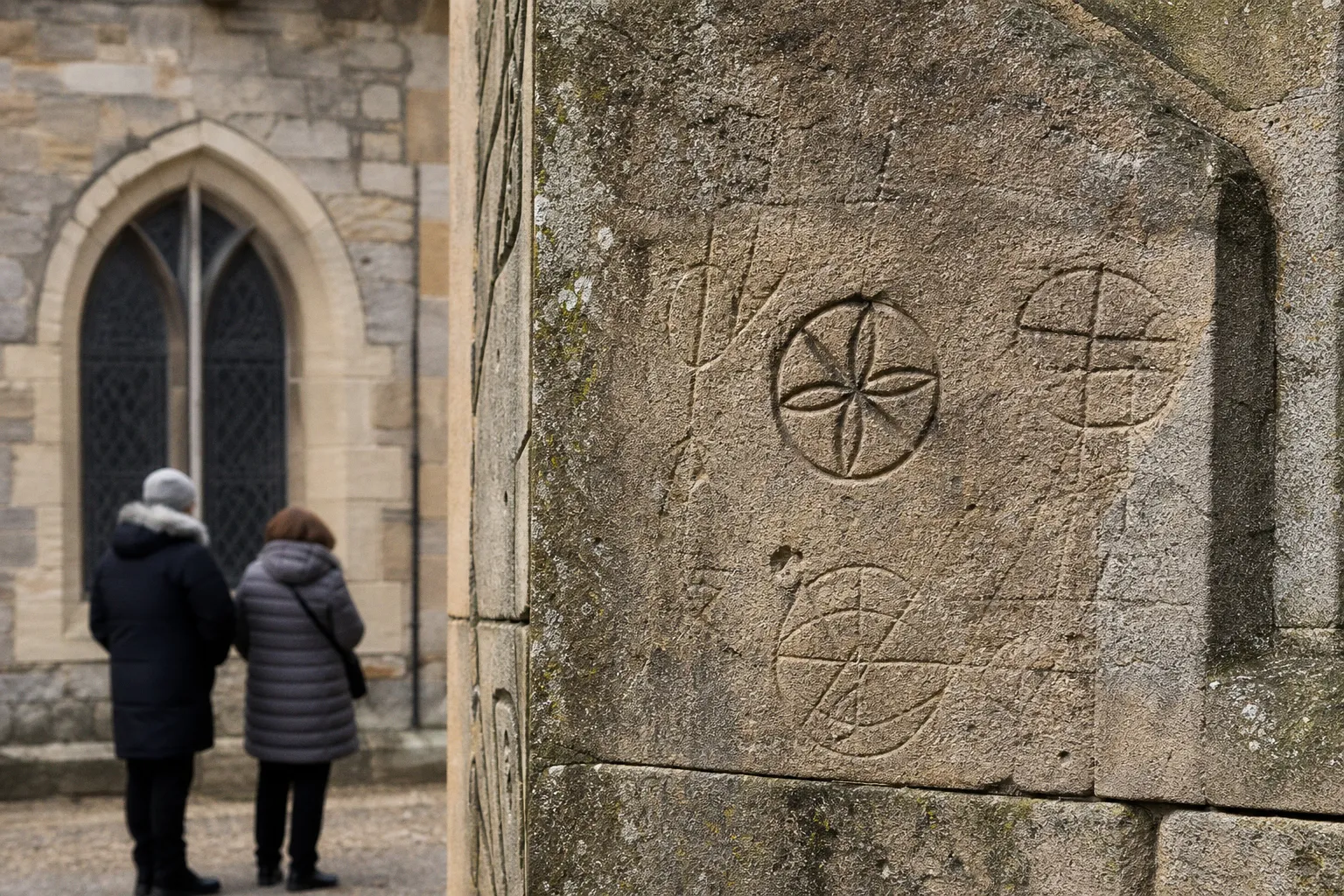
Geometry, not apotropaic function
Alexander's assessment is straightforward. The circular six-petal designs found on barns, churches, and hall walls across England are consistent with the kind of exercises produced when teaching stonecutters to operate compasses on hard, uneven surfaces. Skill levels vary widely across the marks, which aligns with an apprenticeship context rather than a deliberate ritual programme. A 14th-century tithe barn at Bradford-on-Avon, Wiltshire, carries an especially dense concentration of such designs. Alexander interprets this as evidence that the structure, when not serving agricultural storage, functioned as a mason's training shop or schoolroom—not a site saturated with folk protection practices.
The material record supports this reading. Load-bearing masonry of the period required precise geometric layout for arches, vaults, and window tracery. Apprentice stonecutters needed to develop spatial reasoning directly on stone surfaces. Walls of disused or secondary-use buildings offered convenient, expendable practice stock.
Institutional attribution under scrutiny
In 2024, English Heritage announced that Gainsborough Old Hall in Lincolnshire contained "a staggering array" of carved ritual protection marks—more than at any other site in its portfolio of 400 properties. The charity identified overlapping V-shapes as "Marian marks" calling on the Virgin Mary, and simple circles as demon traps. Two years earlier, Historic England had launched a public campaign asking volunteers to locate and catalogue similar symbols, framing them within a narrative of widespread supernatural belief in pre-modern England. Its own website acknowledges that alternative interpretations exist—including the geometric-exercise hypothesis—but states that the "ritual protection" reading remains "the most widely accepted theory."
Alexander rejects this consensus outright. "There's absolutely no evidence they were ever used like that," she told the Guardian. Her position does not deny the existence of apotropaic practices in medieval and early-modern English building culture—foundation deposits, concealed shoes, dried cats in wall voids all have documented archaeological and historical context. What she contests is the specific, uncritical extension of that framework onto what she identifies as workshop geometry.
Interpretive risk for heritage sites
For anyone visiting or studying preserved English buildings, the practical implication is caution against defaulting to the more colourful explanation. Marker stones and incised geometry are frequently cited in site interpretation panels and guidebooks as evidence of folk belief. If Alexander's analysis holds, those panels are misattributing function—turning a masonry classroom into a shrine to superstition. The retrofitting of romantic narratives onto prosaic construction practices is a persistent problem in heritage presentation, one that shapes how visitors understand spatial hierarchy, building phases, and the economic realities of medieval craft training.
Critical scrutiny of such claims applies across domains where evidence is often subordinated to compelling storylines—whether in cultural heritage or strategic analysis under pressure. What Alexander's study demands is not cynicism but methodological rigour: before assigning symbolic meaning to a carved mark, establish what tools made it, in what training context, and with what geometric purpose.