Hanoi food tours: the rise of Old Quarter culinary tourism
A bowl of pho in Hanoi’s Old Quarter now commonly costs 40,000–50,000 VND, about $1.60–$2.00, while a similar bowl in a less touristed neighbourhood may sit closer to 25,000–35,000 VND.
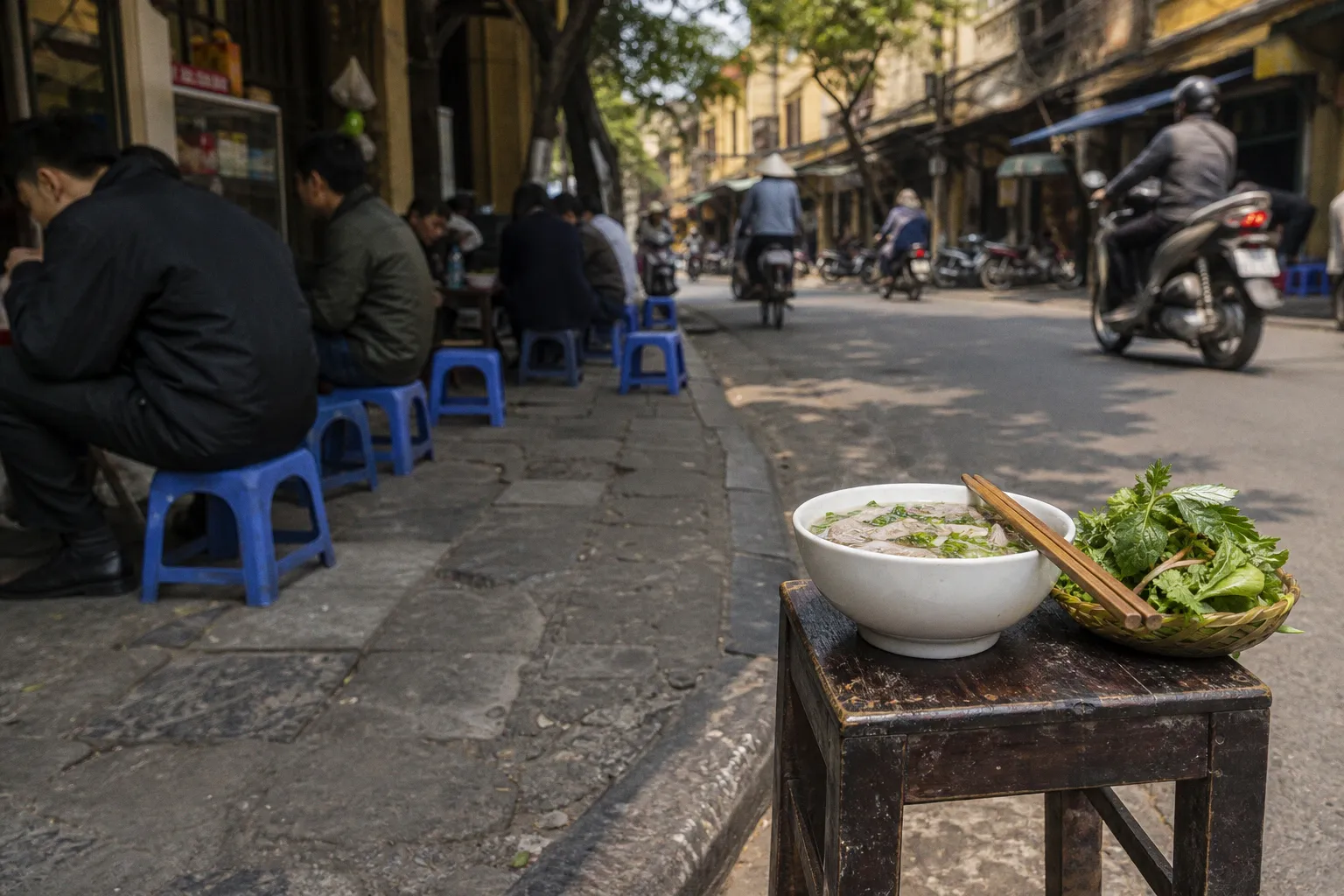
The modern hanoi food tour is built on this tension. It offers three hours, roughly 2.5 kilometres of walking, and a sequence of dishes that seem effortless when they arrive: broth ladled over rice noodles, pork grilled over charcoal, sweetened coffee thickened with egg, sticky rice dyed and pressed and steamed. But nothing in Hanoi’s Old Quarter is effortless. The district’s food economy rests on a thousand years of trade, migration, wet-market logistics, fuel choices, family labour, rents, weather, and the patient calibration of fermented, cured, simmered and grilled ingredients. To walk it properly is not just to eat; it is to read a supply chain written in steam.
From guild streets to food corridors
The Old Quarter is often introduced through the phrase “36 guild streets”, or 36 phố phường, a neat shorthand that does useful work and also risks flattening the place. The district dates back roughly to 1000 CE, when the area around the imperial city developed as a dense trading quarter, with craft villages and merchant families clustered by product and profession. Many street names still begin with “Hàng”, meaning merchandise or goods: Hàng Khoai for tubers, Hàng Bạc for silver, Hàng Gai for hemp or silk-related trade, and so on.
We should be careful here. These streets are not museum aisles, and most no longer sell only the goods implied by their names. Hanoi’s old commercial geography has been stretched by scooters, hotels, cafés, phone shops, souvenir counters, and the appetites of travellers. Yet the logic of specialization has not disappeared. It has simply moved into new forms: one alley becomes known for noodle soups at breakfast, another for grilled pork at lunch, another for late-night sweet soups, another for coffee dense enough to hold a spoon’s memory.
Food tourism entered this structure not as an invention from outside but as a way of packaging a pre-existing urban rhythm. Vendors already worked in narrow units with limited frontage. Families already used pavement space as prep area, dining room, and display counter. Ingredients already moved in early, often before visitors were awake: herbs still damp from wholesale markets, bones for stock, rice noodles from small producers, baskets of limes, green papaya, morning glory, shallots, chillies, and banana leaves.
A hanoi old quarter food tour therefore has a stronger foundation when it explains why dishes belong where they are. Pho is not merely “Vietnam’s famous noodle soup”; it is a broth economy, requiring bones, time, fuel, aromatics, and a daily judgment about clarity and depth. Bún chả is not simply grilled pork with noodles; it depends on pork supply, fish sauce balance, charcoal heat, herbs that bruise if handled badly, and the small arithmetic of dipping sauce. Egg coffee, often described as a novelty, comes from scarcity as much as invention: a way of creating richness when fresh dairy was not always available or affordable.
Hanoi’s food heritage is not decorative. It is a set of practical answers to density, climate, trade, and household labour.
That is what the better guides know. They do not treat the Old Quarter as a tasting board. They trace the movement from ingredient to stall to bowl, and in doing so they make the district legible.
Michelin, TripAdvisor, Time Out — and the problem of being noticed
International attention has arrived with force. Hanoi was voted among the top 20 food destinations globally by TripAdvisor in 2023. In September 2025, Time Out ranked it second in a list of the 10 best street food cities in Asia. The Michelin Guide began recognizing establishments in Hanoi in June 2023 and has since added street-food names such as Pho Khoi Hoi, Pho Lam, and Cham Chicken Pho to its selected list.
For cooks who have spent decades rising before dawn, washing herbs, skimming stock, grinding condiments, and negotiating with suppliers, such recognition can feel overdue. It can bring more customers, better bargaining power, and a measure of dignity in a sector that outsiders have too often romanticised as cheap, informal, and endlessly available. Yet the Michelin effect also changes the atmosphere around a bowl. A stall that once served a neighbourhood flow of workers, students, drivers, and families may find itself mapped, queued, photographed, and reviewed in several languages before noon.
The omission of banh mi vendors from Michelin’s Hanoi selections as of mid-2025 is telling. Banh mi is globally familiar, widely photographed, and easy for visitors to understand: bread, filling, herbs, chilli, pâté, pickles, crispness. Yet in Hanoi’s formal recognition economy, it has not received the same guide-listed presence as pho or chicken noodle stalls. That does not mean the sandwich lacks culinary weight. It means awards systems often move unevenly through a city’s food ecology, favouring certain formats, histories, and dining expectations over others.
This is where culinary tourism needs maturity. A Michelin-selected stall may be excellent; it is not automatically the whole story. A non-listed vendor may be equally important to the daily diet of the quarter. The best food tour in Hanoi is not the one that simply collects the most globally validated names. It is the one that understands how validation itself alters rent pressure, queues, working hours, and the way vendors present their food.
There is also a subtler educational question. Travellers now learn cities through maps, rankings, short videos, and increasingly algorithmic recommendations. The same shift can be seen in other cultural sectors, where AI-powered online learning is here to stay and reshaping how people absorb complex subjects. Food travel is not separate from that trend. A visitor may arrive in Hanoi with a pre-built list produced by platforms rather than by season, neighbourhood knowledge, or conversation. The guide on the pavement must then do more than point; they must unteach simplifications.
What the Old Quarter premium really pays for
The Old Quarter price premium is often discussed too bluntly. Yes, street food in Hoan Kiem district is typically 20% to 30% higher than in non-tourist neighbourhoods. Yes, visitors should understand that they are paying more in the historic core. But the premium is not only a “tourist tax” in the casual sense. It reflects rent, footfall, storage constraints, the cost of staying visible in a crowded market, and the labour of serving a mixed clientele whose expectations may be unpredictable.
A bowl of pho in a residential district can depend on regulars who know the rhythm: where to park, how to order, what time the broth is best, whether to add quẩy, how quickly to move on. In the Old Quarter, vendors may need to explain, translate, slow down, accept photographs, handle dietary questions, and operate beside hostels, boutique hotels, and tour groups. The dish may be the same in structure, but the service environment has changed.
The economics of a typical guided walk make this clearer. Many hanoi culinary tours last around three hours, cover about 2.5 kilometres, and are sold in common time slots such as late morning and early evening. Prices often fall between $15 and $35. Within that fee sit several costs: the tastings themselves, guide labour, agency margin, booking platform commissions in some cases, training, insurance or licensing arrangements where applicable, and the invisible time spent maintaining vendor relationships.
| Element of the tour economy | What the visitor sees | What sits behind it |
|---|---|---|
| Bowl of pho or noodle dish | A quick stop with a hot serving | Bone supply, broth timing, fuel cost, noodle delivery, rent, staff or family labour |
| Guided explanation | A short story about the dish | Language skills, historical knowledge, route design, crowd management |
| Old Quarter location | Convenient walking distance from hotels | Higher rents, heavy competition, tourist-facing service pressure |
| Multiple tastings | Variety across three hours | Vendor coordination, portion negotiation, timing around peak local demand |
| Evening departures | Atmospheric streets and cooler weather | Congestion, limited seating, competition with dinner rush and night-market traffic |
A cheap tour is not automatically exploitative, and an expensive one is not automatically ethical. The more useful question is whether the money circulates fairly through the people doing the cooking, guiding, cleaning, sourcing, and carrying. If a guide knows the vendor’s name, understands the dish beyond a rehearsed sentence, and times the stop so a small kitchen is not overwhelmed, that is a form of care. If a group arrives as a moving wall of cameras, blocks regular customers, and treats a family stall as a backdrop, the price paid at booking tells us very little about its true cost.
In the Old Quarter, “authentic” is not a flavour. It is a relationship between labour, rent, memory, and the right to keep trading.
Hang Buom, Dong Xuan, and the density of appetite
Hang Buom Street shows how quickly Hanoi compresses culinary choice. Around 40 street-food stalls are packed into a 300-metre stretch, with offerings that can include sweet soups, pho, sticky rice, snacks, and late-day dishes that pull office workers, students, residents, and visitors into the same narrow current. For a hanoi street food tour, Hang Buom is tempting because it delivers visible abundance. But abundance needs interpretation.
Sweet soups, or chè, are a good example. They may look to the hurried visitor like colourful dessert cups, but they carry agricultural and regional histories in miniature: beans, lotus seeds, coconut milk, mung bean paste, tapioca pearls, jellies, fruit, sometimes corn, sometimes black sesame. These ingredients speak to preservation, sugar access, tropical harvests, and the pleasure of texture in a humid climate. Sticky rice, too, is not just a filling snack. It is a grain system: soaking, steaming, colouring, topping, wrapping, transporting, and selling while the texture remains resilient rather than clumped.
Dong Xuan Night Market operates on a larger scale. Running since 2003, it opens on Friday, Saturday, and Sunday nights from 6:00 PM to 11:00 PM, stretching about 3 kilometres from Hang Dao to the Dong Xuan Market gate and hosting around 4,000 stalls. Those numbers are impressive, but the lived experience is not simply size. Night markets alter the food economy by shifting demand into leisure hours, when visitors stroll, snack, compare, and graze rather than sit for a full meal. That suits some foods better than others.
Skewers, fried snacks, sweet drinks, compact noodle portions, and portable sweets flourish in this setting. Long-simmered dishes with more complicated seating needs are harder to manage unless the vendor has a stable corner. The market also changes how heritage is staged. A dish that was once tied to a morning market routine may be adapted for night-time sampling. Portions shrink. Garnishes become more visible. English signs appear. Payment becomes quicker. None of this automatically empties the food of meaning, but it does change the way it is produced and consumed.
For historic old towns, this is a familiar pattern. Culinary heritage becomes one of the most accessible forms of tourism because it does not require a museum ticket or architectural vocabulary. A traveller may not understand tube-house construction or guild taxation, but they can understand a ladle of broth. The risk is that food becomes the only history consumed, stripped from the buildings, courtyards, shrines, markets, and trade routes that made it possible.
The stronger Hanoi tours resist that narrowing. They use food to reopen the city, not close it. A stop near Dong Xuan should lead naturally to wholesale supply, market hours, weekend pedestrian flows, and the way the old trading district has absorbed modern tourism without losing all of its local function.
The anatomy of a good Hanoi food tour
A standard three-hour route has a practical limit. It cannot tell a thousand years of urban history in full, nor should it try. It must choose. The most successful guides make those choices visible enough that the visitor understands why one dish has been included and another left out.
A balanced itinerary usually does several things:
1. Begins with a staple rather than a spectacle. Pho, bún, xôi, or another foundational dish gives the visitor a grammar of rice, broth, herbs, fish sauce, meat, and heat. Starting with the most photogenic item can distort the palate and the story.
2. Moves through different cooking methods. A good route should not be all soup or all snacks. Simmering, grilling, steaming, frying, fermenting, and brewing each reveal different kinds of labour and different historical necessities.
3. Explains the market chain. Herbs do not appear by magic, and neither do bones, noodles, coffee beans, eggs, pork, or pickles. Even a brief account of where ingredients are sourced and when they arrive deepens the tasting.
4. Leaves room for the ordinary. A stall does not need an award, a viral video, or a dramatic origin story to matter. Daily food is often where the clearest heritage sits.
5. Manages group behaviour. Narrow pavements are workplaces. The guide should keep the group from blocking service, over-photographing cooks, or lingering after the eating is done.
6. Names change without mourning every change as loss. Hanoi’s food culture has always adapted. The question is not whether the Old Quarter changes, but who benefits, who is displaced, and which skills remain viable.
This last point matters. Culinary heritage is too often frozen into a sentimental picture: grandmother’s recipe, charcoal stove, handwritten sign, unchanged flavour. Some of that may be true. Much of it is incomplete. Families change suppliers because a farm stops producing. They adjust seasoning because customers shift. They raise prices because rent rises. They add a laminated English menu because a queue of foreign visitors cannot read the old board. They switch fuel because of safety rules, cost, or neighbour complaints. Tradition is not stillness; it is disciplined adaptation.
Tourism growth and the pressure on the bowl
Hanoi’s broader tourism numbers sharpen the question. In the first four months of 2026, the city welcomed 12.14 million visitors, a 20.9% year-on-year increase, and generated $1.93 billion in tourism revenue. Food is not a side note in that economy. It is one of the main reasons travellers choose the city, and one of the fastest ways money reaches small operators — if the structure allows it to reach them.
The Old Quarter benefits from concentration. Hotels, markets, guild streets, coffee shops, temples, and tour meeting points sit close enough to build a dense visitor circuit. That same concentration produces strain: waste, congestion, rising rents, pressure on pavement space, and a tendency to simplify menus for speed. A vendor who once sold primarily to locals may face a decision between preserving the old service rhythm and adapting to tourist demand. Neither choice is morally simple.
There is also a question of time. Many visitors arrive with one evening and a booking confirmation. They want the “best food tour in Hanoi”, but best for whom? Best for variety, for historical explanation, for vendor income, for hygiene confidence, for small-group access, for avoiding crowds, for late-night atmosphere? These are not identical aims. A tour built for first-time visitors may reasonably include pho and egg coffee. A more specialist walk might focus on fermented condiments, market ingredients, northern rice preparations, or the Chinese and French inflections that shaped parts of Hanoi’s table. The city can support both, but not if every route repeats the same five stops.
For old-town tourism, repetition is the quiet danger. When every guidebook, platform, and influencer names the same dishes in the same order, culinary districts become narrower even as crowds grow. The answer is not to hide famous foods from visitors. Pho deserves its place. Bún chả deserves its place. Egg coffee, when made with care rather than gimmickry, tells a real story. But the route should leave openings: for bitter herbs, snail dishes, green rice, steamed rice rolls, pickled bamboo shoots, seasonal fruits, tofu, and the many modest preparations that do not travel as easily on camera.
What we should ask of the next stage
Hanoi’s Old Quarter has always been commercial. We should not pretend tourism has corrupted a pure, untouched food world. The guild streets were built around exchange: goods arriving, skills clustering, families competing, names sticking to products and trades. Today’s hanoi food tour is another layer in that long mercantile history.
The question is whether this new layer will honour the systems beneath it. That means paying attention to price without reducing every meal to a bargain. It means respecting the labour of the person who braises, cures, grills, ferments, washes, carries, and serves. It means treating Michelin recognition as one signal, not a final verdict. It means seeing Hang Buom not only as a strip of snacks, and Dong Xuan not only as a weekend spectacle, but as parts of a working food city negotiating global attention.
For travellers, the practical lesson is simple enough. Walk slowly. Ask what time the broth was started. Notice who is eating beside you. Let the guide talk about rent and sourcing, not only flavour. Accept that the Old Quarter premium is part of the district’s current reality, but do not confuse a higher price with deeper heritage. The real value of a good Hanoi culinary tour is not the number of dishes it fits into three hours. It is whether, after those 2.5 kilometres, we understand more clearly how a thousand-year-old trading quarter continues to feed itself while feeding the world’s curiosity.