Lisbon food tour: Traditional Alfama vs multicultural Mouraria
The first decision on a Lisbon food tour is not what to eat. It is where to place your feet.
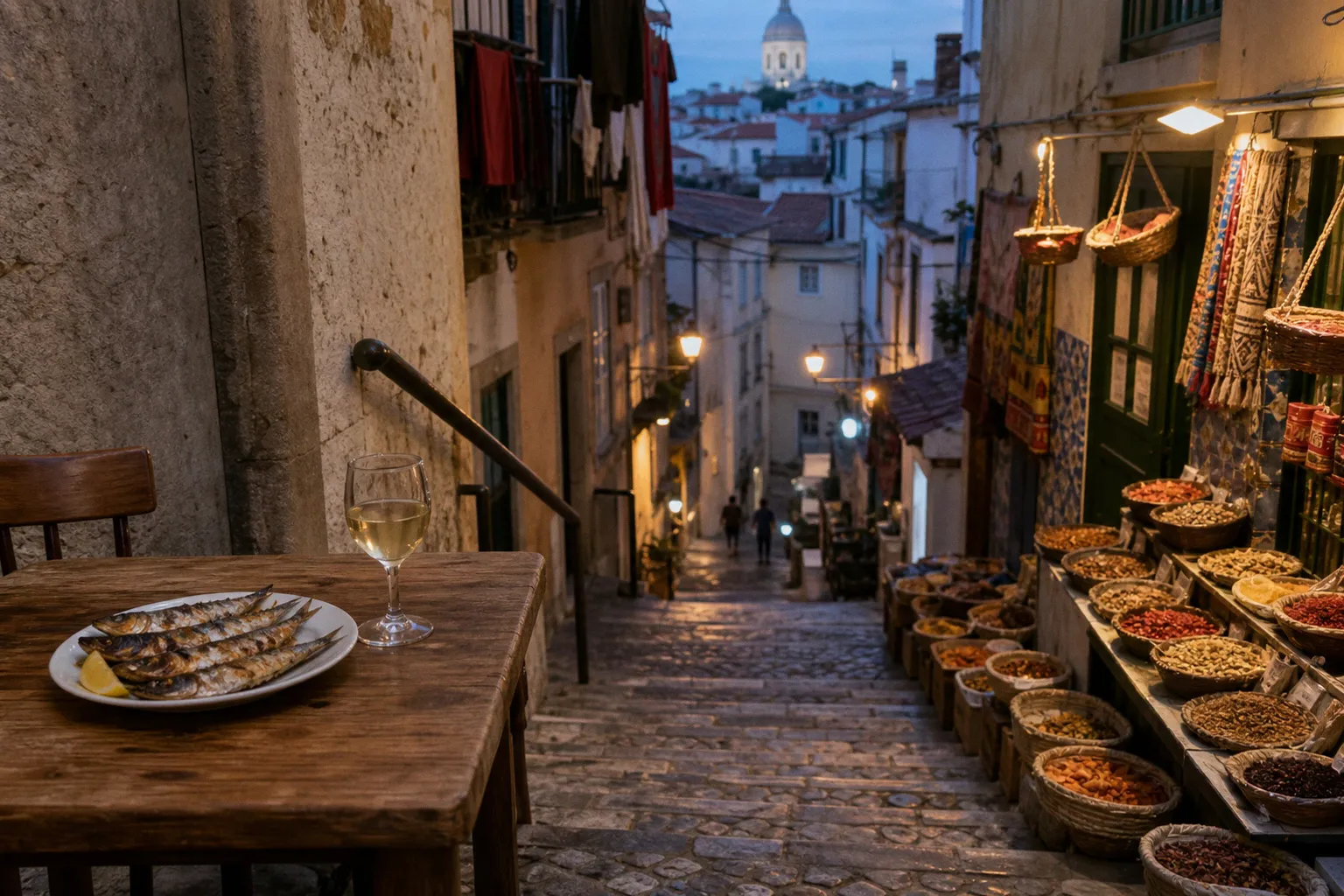
Alfama and Mouraria sit close together on the old-city map, but they operate on different axes. Alfama is a steep, tightly layered descent toward the Tagus, with fado restaurants embedded in residential lanes and a culinary identity built around familiar Portuguese dishes. Mouraria runs on the inland side of the historic core, feeding into Martim Moniz and its long-established migrant communities, food counters and cross-cultural routes.
Do not reduce this to “traditional Alfama” versus “international Mouraria.” That shortcut misses the city. Both quarters hold Portuguese food, fado and centuries of exchange. The practical distinction is sharper: Alfama gives you a more concentrated evening of classic dishes and performance; Mouraria gives you a wider culinary field, where Lisbon’s Portuguese foundations meet African, Asian and other migrant food traditions.
For a heritage traveller, that is the real route choice.
The Fado Connection: one music, two different operating environments
Fado is the most obvious bridge between Alfama and Mouraria, and it is not a decorative one. UNESCO placed Fado, urban popular song of Portugal, on its Representative List of the Intangible Cultural Heritage of Humanity in 2011. Its description matters: fado is a multicultural synthesis, shaped by Afro-Brazilian sung dances, local urban genres, rural traditions brought to Lisbon by internal migration, and early nineteenth-century song patterns.
That history should stop any guide from treating fado as a sealed, pure object. It grew through movement.
Mouraria carries one of the central origin stories. After the Christian reconquest of Lisbon in 1147, the area was where Moors were permitted to live. Some scholars identify it as a possible cradle of fado, though “possible” is the operative word. Lisbon has competing fado origin narratives, and certainty here is usually a sales pitch rather than history.
Alfama, meanwhile, is the more efficient choice if you want fado built directly into dinner. The quarter’s restaurant network has long paired Portuguese cooking with performances, and the streets create a useful compact circuit: climb or descend once, commit to a venue, then leave slowly toward the river or take a taxi from the perimeter.
Parreirinha de Alfama is the reference point. Founded by fado singer Argentina Santos in the early 1950s, it is among Lisbon’s oldest and best-known fado restaurants. Its significance is not merely longevity. It represents the Alfama format clearly: traditional Portuguese dishes first, fado as the night’s structured centre of gravity.
Mouraria has its own anchor at Maria da Mouraria, housed in the former Casa da Severa and described locally as the district’s only fado house. It serves Portuguese food, which is a necessary correction to the idea that Mouraria is somehow outside Lisbon’s traditional table.
| Route question | Alfama | Mouraria |
|---|---|---|
| Best fit for | A dinner-led food walk with fado as the fixed destination | A wider walking route where fado is one cultural stop among several |
| Spatial logic | Steep lanes, riverward slope, slower exit after dinner | Better connection to Martim Moniz, Baixa and central transit |
| Culinary emphasis | Established Portuguese dishes in fado-restaurant settings | Portuguese cooking alongside visible migrant and cross-cultural food traditions |
| Fado role | Often the main event | Historically important, but not the only reason to visit |
| Evening pace | Reserved, seated, performance-timed | More flexible, street-facing, easier to combine with other stops |
The listed restaurant spending band for both Parreirinha de Alfama and Maria da Mouraria is €20–€50. Treat that as a venue category, not as the going rate for a guided Lisbon food tour. A tour’s value depends on its route, group size, tastings and duration; there is no single standard package across the two districts.
In Alfama, book the dinner and build the walk around it. In Mouraria, build the walk first and let the food stops shape the evening.
Traditional Portuguese flavours: what the word “traditional” actually means
A good Alfama vs Mouraria food walk should not promise obscure dishes at every turn. Lisbon’s culinary heritage is often plain in construction and exact in execution: salt cod, olive oil, eggs, potatoes, grilled fish, bread, parsley, onions. The test is not novelty. The test is whether the kitchen understands proportion, heat and timing.
Start with bacalhau à Brás, one of the city’s most recognisable cod dishes. It is made from shredded salt cod sautéed with onions and fine fried potato strips, then bound with whisked egg and finished with black olives and parsley. In a careless kitchen, it becomes a dry heap of potatoes with cod fragments. In a competent one, the egg remains soft, the cod stays distinct, and the potato provides texture rather than bulk.
Then there are sardines. Grilled sardines are a Lisbon icon, often served on bread or with grilled peppers and boiled potatoes. Their strongest public association comes during the Santos Populares festivities, when traditional neighbourhoods fill with street barbecues. Outside that festival context, do not expect every narrow lane to function as a permanent sardine grill. That is another common distortion of the city.
Use this three-stop sequence if you are assembling an independent tasting route:
1. Begin with a cod dish in a seated restaurant. Bacalhau à Brás is useful because it establishes the core Portuguese pantry: preserved fish, egg, potato and olive oil. Eat it early, before wine and performance schedules slow the route.
2. Move to a small petiscos stop rather than ordering a second full meal. You need contrast, not volume. Ask for a modest plate that uses local staples without repeating the cod-and-potato formula.
3. Reserve grilled sardines for the right season and setting. During Santos Populares, they are part of the street-level ritual. At other times, treat them as a restaurant choice, not a guarantee of neighbourhood theatre.
4. Keep fado dinner as the final anchor. Once the music begins, the logistical window closes. You will not want to be calculating a cross-city transfer or hunting for another tasting.
Alfama is better at this progression because its food heritage and fado economy are closely coupled. You are not rushing between unrelated attractions. You are following a single historical corridor: household cooking, tavern culture, restaurant dining, performance.
That does not mean every establishment in Alfama is automatically authentic. The district’s popularity creates bottlenecks, especially at dinner. A menu with a few translated classics is not evidence of culinary depth. Look for restraint: dishes that make sense together, a kitchen that is not trying to serve every Portuguese cliché at once, and a service rhythm that acknowledges the performance rather than treating it as background noise.
Mouraria’s multicultural layer is not a detour from Lisbon
Mouraria is often framed as the alternative to the “real” Lisbon of Alfama. That framing is historically weak and operationally unhelpful.
The district has deep Portuguese and fado associations. It also sits beside Martim Moniz, one of the clearest access points to Lisbon’s contemporary multicultural food landscape. The result is not a clean split between old and new. It is a working overlap.
Lisbon’s official tourism material documents African culinary venues and dishes across the city on a route that runs from Mouraria to Alfama. The examples are specific: Cape Verdean cachupa; Angolan muamba, funge and calulu; Mozambican samosas; shrimp or crab curry. These are not generic “world food” labels. They point to Lusophone connections formed through migration, colonial history, language and everyday urban life.
Cachupa, for example, is the Cape Verdean slow-cooked staple built around corn and beans, often with vegetables and meat or fish depending on the version. It asks for time. Muamba, associated with Angola, is a rich stew, while funge is a starchy accompaniment whose texture matters as much as flavour. Mozambican curries and samosas introduce a different line of influence, including the Indian Ocean networks that shaped East African cooking.
You do not need to turn a Mouraria walk into a geopolitical lecture. But you should understand why the food is there. These dishes are part of Lisbon’s urban culinary history now, not imported props arranged for visitors.
The Martim Moniz edge is the key transit point. During Mouraria’s 2011–2012 requalification, the Council of Europe documented the Fusion Market project in the area, describing more than ten stalls serving freshly prepared street food from multiple continents. That confirms the scale and intention of the initiative at the time. It does not confirm a present-day stall count, vendor list or opening schedule. Do not plan a 2026 itinerary around an old market description without verifying current conditions on the ground.
The better approach is to use Mouraria as a flexible food corridor:
- Start near Martim Moniz while the transit links are simple and the street-level food options are broad.
- Move uphill and inward through Mouraria for Portuguese snacks, bakeries or a fado-linked stop.
- Finish toward Rossio, Baixa or the Avenida side if you want an easy exit; do not force a late climb into Alfama unless you have a reservation there.
- If your route continues to Alfama, make the transfer purposeful: fado dinner, a specific tavern or a scheduled viewpoint stop. The two districts are close on a map, but their elevation and lane geometry can turn a casual detour into a slow, tiring bypass.
Mouraria is not “less Lisbon” because its table is wider. It is Lisbon with more of its routes still visible.
The market myth: Feira da Ladra is not where you go to eat
Many Lisbon culinary walking tours make a geographic error before they begin: they confuse any historic market with a food market.
Feira da Ladra, held at Mercado de Santa Clara in the Alfama area, is not a food market. It is Lisbon’s traditional flea market, dealing in second-hand objects, antiques and miscellaneous goods. Its origins are traced to the thirteenth century, and it operates on Tuesdays and Saturdays throughout the year.
It belongs on an Alfama-area itinerary if you are interested in the trading history of the city, material culture, old print, tools, religious objects or the sheer mechanics of a long-running street market. It does not belong in a food-tour promise as a culinary stop.
This matters because old-town routes have limited capacity. If you have three hours, every wrong turn costs you twice: once in walking time and once in appetite. Feira da Ladra sits at a useful northern edge of the Alfama zone, but it should be treated as a separate module.
Here is the efficient split:
| If your priority is | Use the morning or afternoon for | Use the evening for |
|---|---|---|
| Historic market culture | Feira da Ladra on Tuesday or Saturday | A planned Portuguese dinner elsewhere in Alfama |
| Traditional Lisbon food | A compact Alfama tasting route, avoiding unnecessary hill reversals | Fado restaurant reservation |
| Multicultural food context | Mouraria and the Martim Moniz perimeter | Flexible small plates or a fado house if booked |
| A combined heritage day | Feira da Ladra first, then descend through Alfama with a substantial break | One district only for dinner; do not overbuild the route |
The practical error is trying to do everything in a single continuous march: flea market, Alfama viewpoints, Mouraria snacks, Martim Moniz, then fado dinner. That route is possible only if you accept that the food becomes incidental and the streets become the main event.
For a culinary-focused day, divide the map. Markets and food require different attention. A flea market rewards browsing; a meal needs timing; fado requires a reservation and patience. Put each on the correct axis.
How to choose between Alfama and Mouraria
Choose Alfama if your definition of a Lisbon food tour is rooted in the classic Portuguese table and you want fado to be structurally central. This is the route for travellers who want to understand why cod, grilled fish, wine, petiscos and song are often presented together. It is also the better choice for a single decisive evening.
But accept the terrain. Alfama is not a district to treat as a straight-line tasting crawl. Its elevation creates friction. Pick one approach route, arrive early, and avoid zigzagging between distant recommendations. A restaurant reservation is your fixed point; every earlier stop must feed into it.
Choose Mouraria if you want Lisbon’s food history to include migration, language, empire, labour and contemporary community life. You can still eat Portuguese dishes and hear fado here. The difference is that the route does not insist on one culinary script. It gives you more choices, more transitions and easier connections to central Lisbon.
Mouraria also works better if you dislike the pressure of a formal dinner. You can sample across several smaller stops, move through Martim Moniz, and retain a clean transit exit. That flexibility is not a lesser experience. It is a different route architecture.
For the strongest comparison, do not book two nearly identical “old Lisbon food tours” on consecutive days. Create contrast deliberately:
- Take Alfama after dark, with a booked table at a serious fado restaurant and a narrow tasting plan beforehand.
- Take Mouraria earlier in the day or at the start of the evening, focusing on its layered food geography rather than chasing a fixed list of dishes.
- Keep one meal in each district Portuguese. Otherwise you are comparing guides’ preferences, not the quarters themselves.
- In Mouraria, add one African or other migrant-food stop that you genuinely want to understand, not merely photograph.
- Leave Feira da Ladra outside the food itinerary unless your interest is the market itself.
The route decision is the heritage decision
The best food tours in Lisbon’s old town do not turn neighbourhoods into opposing brands. Alfama is not a museum of frozen Portuguese cooking. Mouraria is not a convenient label for everything “global.” Their food cultures overlap because Lisbon’s history overlaps: through fado, migration, trade, internal movement and the constant pressure of a port city remaking itself.
Still, you should choose with discipline.
Take Alfama when you want the concentrated, dinner-led line: Portuguese cooking, a fixed table, fado, and a steep but coherent old-town route. Take Mouraria when you want the broader field: Portuguese foundations alongside African and international culinary currents, with Martim Moniz providing the transit and food-service hinge.
Do not try to consume both districts as one blur. Set the route, protect the meal, and let the neighbourhood tell its own story at the pace its streets permit.