Schwerin Residence Ensemble: Exploring the New UNESCO World Heritage Site
According to Deutsche Welle, Germany’s Schwerin Residence Ensemble has been granted UNESCO World Heritage status.
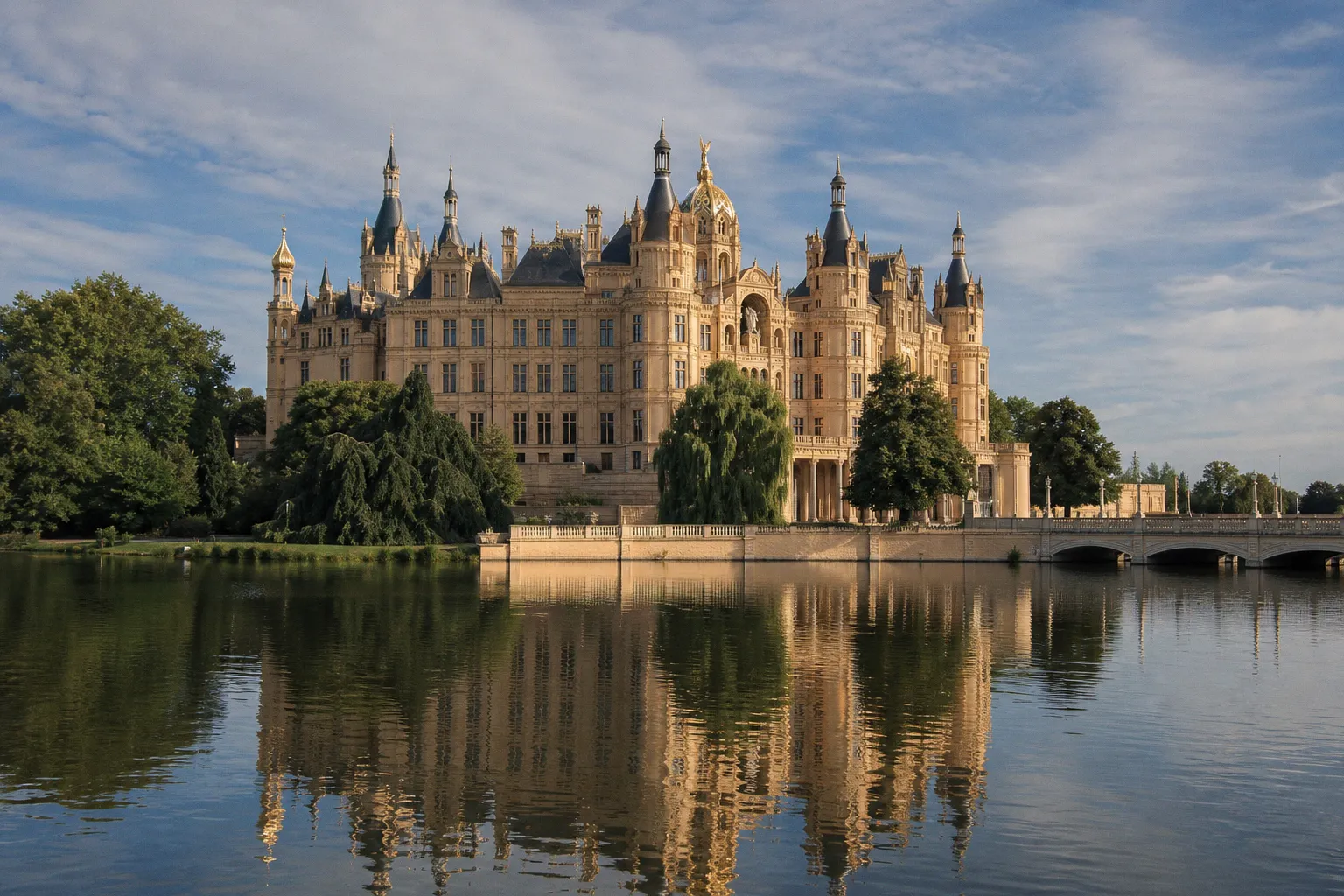
The designation covers Schwerin Castle and surrounding historic buildings from the 19th century. For visitors, the relevant point is not a new attraction but a newly formalised heritage framework around an existing architectural group.
A designation for an ensemble, not a single façade
The reported inscription concerns a residence ensemble. This distinction matters. The heritage value is not confined to the castle as an isolated object; it also includes its relationship with the surrounding 19th-century historic buildings.
Such recognition directs attention to spatial hierarchy: the principal residence, its setting, and the supporting built fabric must be read as one composition. A visit limited to the castle exterior risks reducing the site to an image. The more useful approach is to examine the transitions between monumental and ancillary structures, the scale of streets and open space, and the continuity of the historic building group.
Deutsche Welle’s report does not specify the inscription boundary, management provisions, access arrangements, or any changes to ticketing and visitor circulation. Those matters should therefore not be assumed from the UNESCO designation alone.
What travellers should verify
World Heritage status is often treated as evidence that a place has become easier to visit. It is not. A designation identifies heritage significance; it does not, by itself, confirm opening hours, restoration schedules, transport capacity, or public access to every component of an ensemble.
Travellers planning Schwerin should verify which parts of the residence complex and adjacent historic buildings are accessible on their intended dates. They should also distinguish between a building’s visual presence in the urban composition and its actual availability for entry. These are separate conditions.
The designation may also sharpen attention on the less conspicuous structures around the castle. In preservation terms, masonry walls, rooflines, service buildings and the spacing between structures can be as consequential as a landmark façade. Their contribution lies in the coherence of the group, not necessarily in individual spectacle.
For readers considering a road-based itinerary, vehicle choices are a separate practical question from heritage status; the current industrial context is outlined in this survey of the Chinese automotive giants’ 2026 market.
The preservation question remains operational
The available report establishes the new UNESCO status and identifies the castle and surrounding 19th-century buildings. It does not describe particular conservation works, material failures, retrofitting schemes, or planning controls. No claim can therefore be made about the condition of individual façades, mortar, structural elements, or interiors.
That limitation is significant. Heritage designation records recognised value, but preservation is carried out through continuing maintenance, compatible repair and management of use. For Schwerin, the immediate value for architectural visitors is the opportunity to assess a residence complex as a connected historic environment rather than as a detached castle visit.